
AI-NAV · Article
No Company? How Solo Developers in China Can Get Paid Globally (Stripe, PayPal, Paddle and Creem Compared)
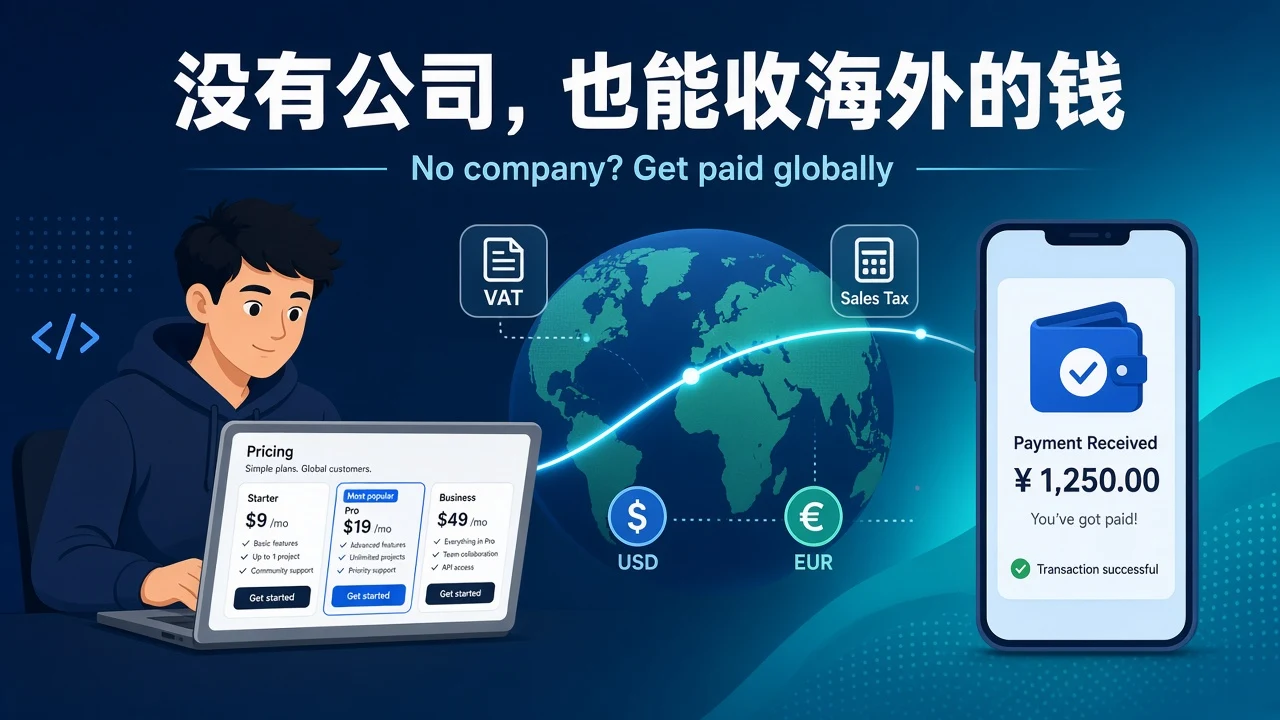
Checked on 14 November 2026. Fees and rules come from each provider's own pricing pages and docs, and they change. Check the official page before you commit. This is not legal or tax advice.
You built an AI product and people abroad want to pay for it. If you are an individual developer in mainland China with no registered company, the checkout is often where the project stalls. The friction comes in three parts:
- Entity. Several mainstream processors do not onboard mainland China merchants, so the usual advice is to form a US or Hong Kong company first.
- Tax. Selling to consumers in the EU, UK or US means collecting VAT or sales tax by the buyer's location. That is hard to manage as one person.
- Payout. Once the money is collected, it still has to reach a Chinese bank card or Alipay, and every hop costs something.
Below, each option is checked against three questions: can an individual sign up, what identity checks are needed, and how does the money get back to China.
The options at a glance
| Option | Individual in mainland China, no company | Personal KYC | Merchant of record | Standard fee (official) | Getting paid in China |
|---|---|---|---|---|---|
| Stripe | Hong Kong is on Stripe's supported list; mainland China is not | Per account country | No (Managed Payments is a separate MoR product) | US: 2.9% + 30¢, +1.5% international cards | Needs a company and bank account in a supported country |
| Stripe Atlas | Forms a Delaware company online | Yes | No, it is incorporation | US$500 incl. first-year registered agent, then US$100/yr | Through the US company |
| PayPal (China cross-border account) | A mainland China fee schedule exists | Yes | No | 4.40% + US$0.30 on international receipts | US$35 per wire to a mainland bank, or RMB settlement via paypal.cn |
| Paddle | Individuals and sole traders skip business verification; China is not on its unsupported list | Government ID + proof of address, sometimes liveness | Yes | 5% + 50¢ | Monthly wire or Payoneer, US$100 minimum, CNY available |
| Lemon Squeezy | Supports countries that can receive bank or PayPal payouts; mainland China is not on the bank list | Yes | Yes | 5% + 50¢, +1.5% international, +1.5% PayPal, +0.5% subscriptions | 1% per bank payout outside the US; PayPal 3% capped at US$30 |
| Creem | China is on the supported merchant list; natural persons can be merchants | ID; KYB only if you have a company | Yes | 3.9% + 40¢ | Individuals: Alipay. Companies: local bank. Or USDC |
Some context on each:
- Stripe. The usual workaround is a Hong Kong company or a US company formed through Stripe Atlas. Atlas solves incorporation, but running the company, including filings, is still yours. Stripe also documents
reserve_hold, where it holds part of your balance in reserve to manage risk. - PayPal. The fees stack. You pay 4.40% + US$0.30 to receive, then US$35 for each wire to a mainland bank. Alternatively, paypal.cn's cross-border collection settles to RMB at a promotional 0.5% (standard 1.0%) plus 6% VAT on that fee, from 15 January to 31 December 2026. PayPal is not a merchant of record, so overseas consumption tax stays with you.
- Paddle. A mature merchant of record that accepts individuals. Verification runs in three stages: domain review, business verification (skipped for individuals) and identity verification. Its help centre lists only wire transfer and Payoneer for payouts. Sellers have also reported that PayPal payouts end on 28 February 2026, though that comes from community posts, not a Paddle page.
- Lemon Squeezy. Stripe acquired it in 2024. In a 28 January 2026 post, its CEO said the team is building Stripe Managed Payments, which currently supports merchants in 35+ countries. For founders outside Stripe's countries, he pointed to Atlas. If you plan to stay long term, watch how the platform changes.
Why Creem fits founders without a company
Creem is a merchant of record. Legally, the customer buys from Creem, and Creem calculates, collects and remits VAT, GST and sales tax across 190+ countries. It also handles refunds and chargebacks. For a solo founder, that addresses all three problems:
- Entity. China is on Creem's list of 87 supported merchant countries. Its merchant terms define a merchant as "any natural person or a legal entity", and onboarding asks for your individual name and/or business name.
- Tax. The FAQ says you don't need to register for tax in any country. Checkout adds the right tax for the buyer's location.
- Payout. The docs say Chinese individual recipients are paid to Alipay and business recipients to a local bank account. Alipay is capped at CNY 50,000 per payout and CNY 300,000–600,000 a year. USDC on Polygon is also available, for a 2% fee.
The fee is 3.9% + US$0.40 per successful transaction, with no monthly or setup fee. Creem says there are no international card fees. In its own worked example, a French buyer pays US$24 for a US$20 product plus 20% VAT. The platform fee is US$1.33, and you net US$18.67. Bank payouts cost US$7 or 1%, whichever is higher.
The product covers one-time payments, subscriptions, trials, seat-based and usage-based billing, license keys, discounts, affiliates, a customer portal and webhooks. You can integrate through the API, the TypeScript SDK, the Next.js adapter or the CLI. With no code, you can use hosted checkout links, Storefronts or the Framer integration.
Getting started with Creem, step by step
Creem's site is English-only for now. The screenshots below were taken on 14 November 2026.
Step 1: Open the site and check your product is allowed.
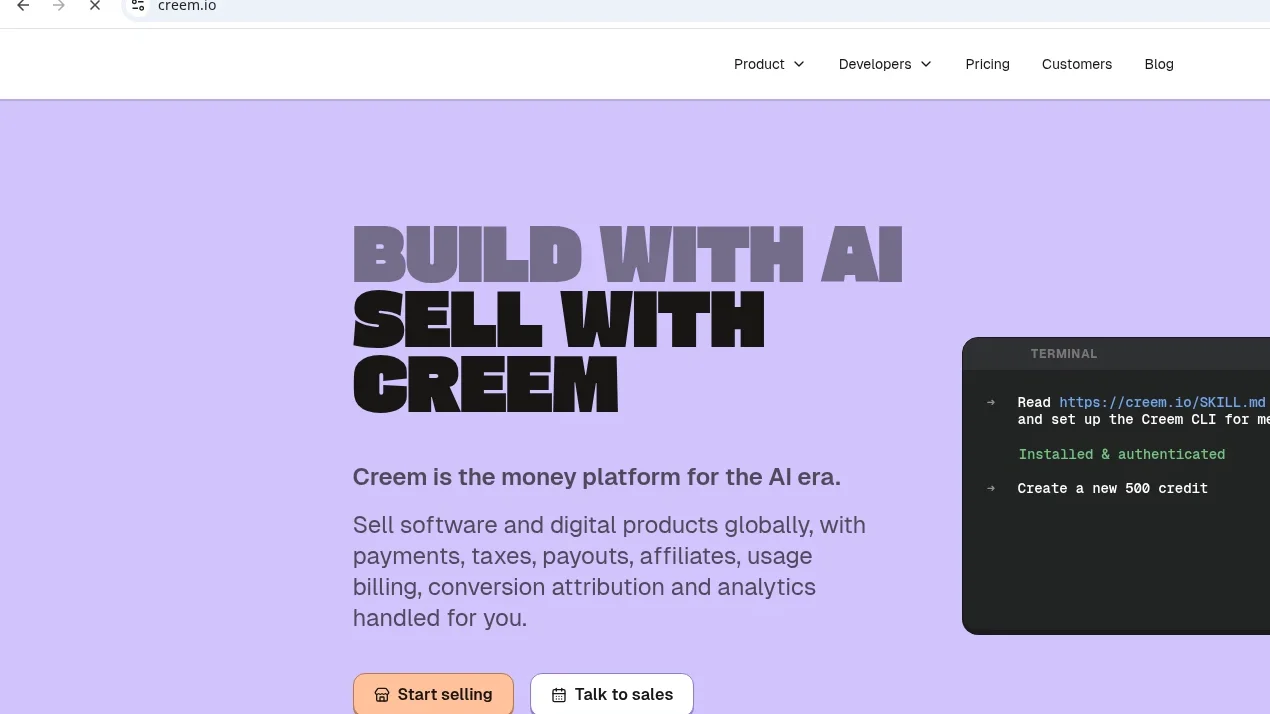
Figure 1: The Creem homepage, with the "Build with AI. Sell with Creem" headline and the Start selling button.
Read the prohibited and restricted lists below before you sign up. If your product generates images or video, read them twice.
Step 2: Check the fees.
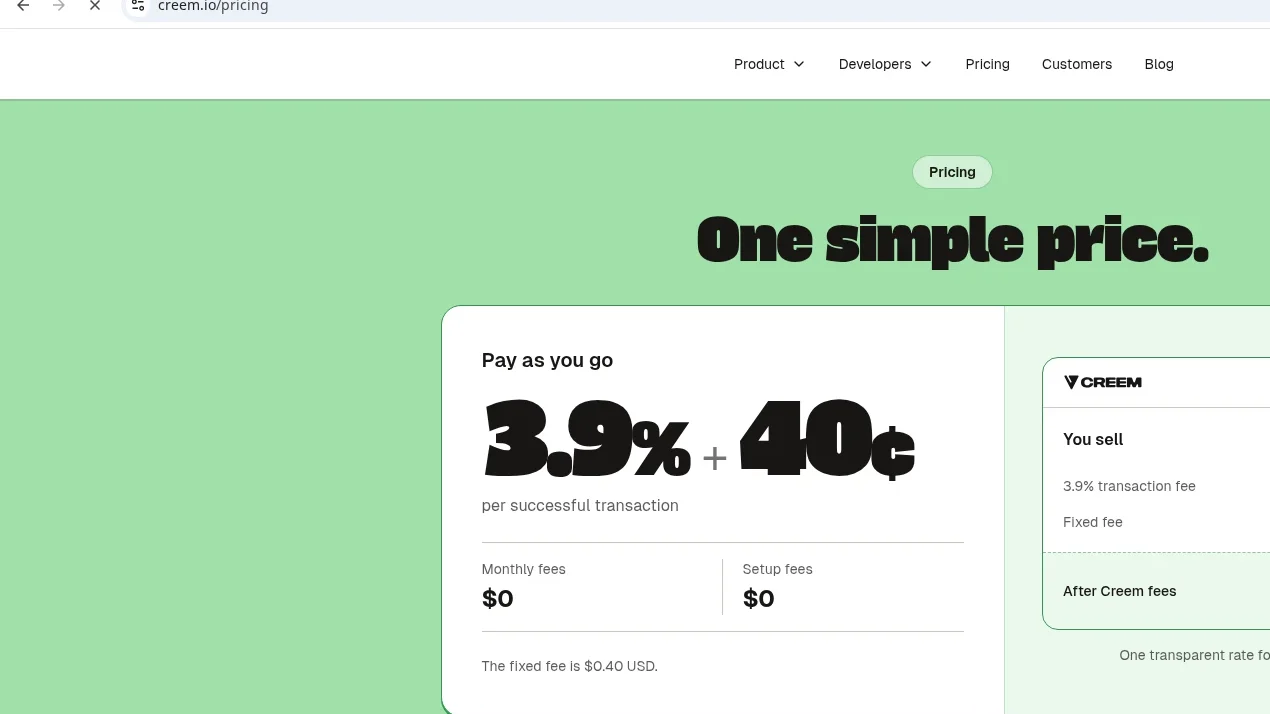
Figure 2: creem.io/pricing lists 3.9% + 40¢ per successful transaction, with $0 monthly and setup fees. In the $100 example you keep $95.70. Payout fees are separate.
Step 3: Understand what Creem takes off your plate.
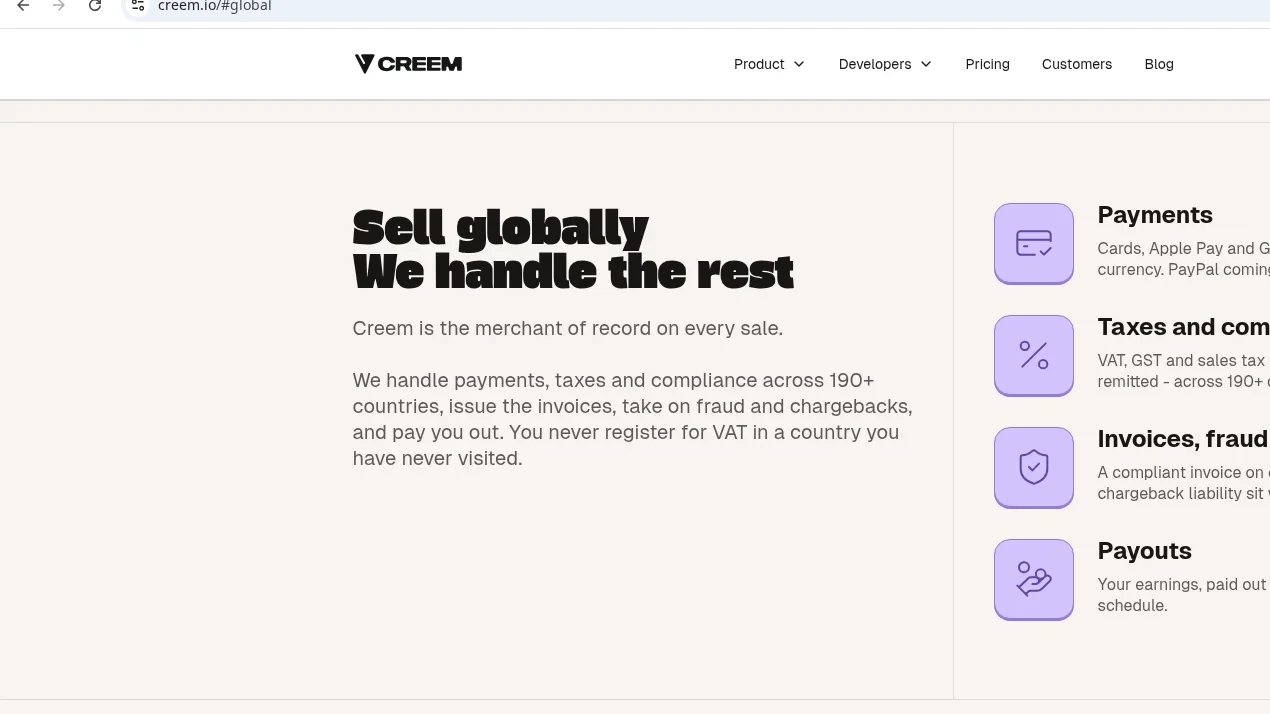
Figure 3: "Sell globally. We handle the rest." Creem is the merchant of record on every sale and covers payments, VAT, GST and sales tax across 190+ countries, invoices, fraud and chargebacks, then pays you on a set schedule. Individuals in China can choose Alipay in the dashboard.
Step 4: Create an account.
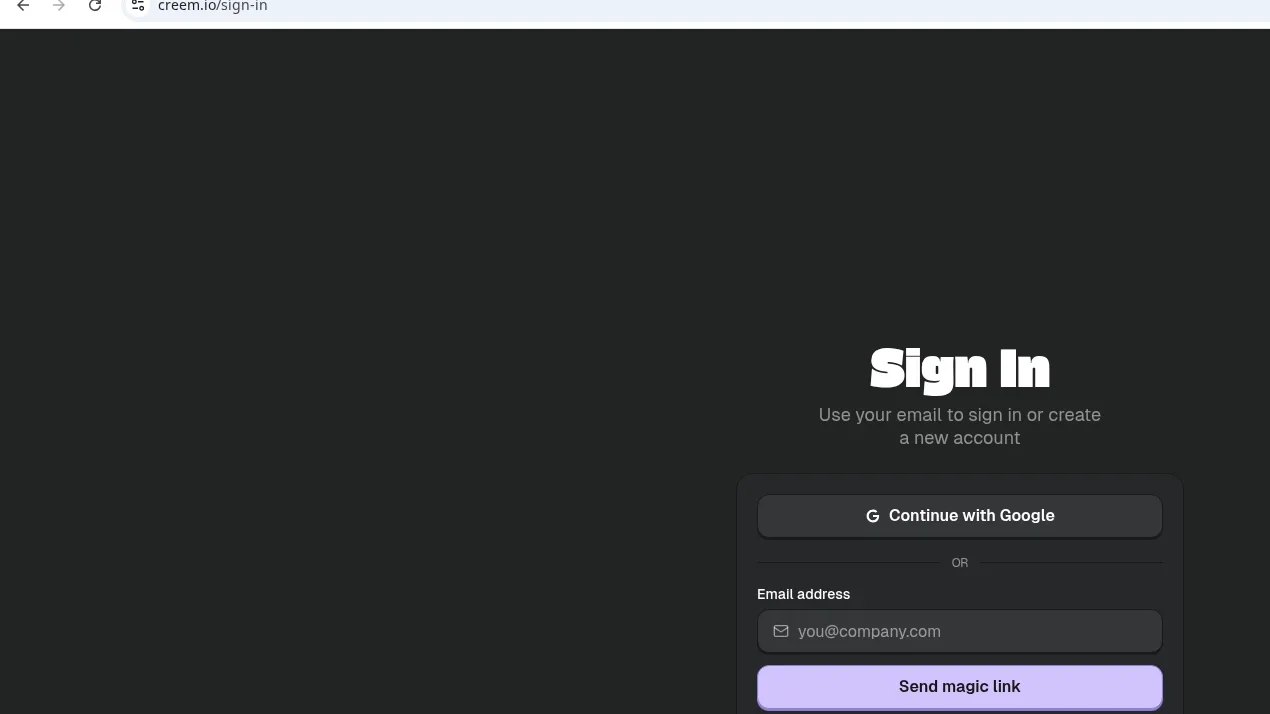
Figure 4: creem.io/sign-in. Continue with Google, or enter your email address to get a magic link. No invite code is needed.
Step 5: Follow the quickstart and test first.
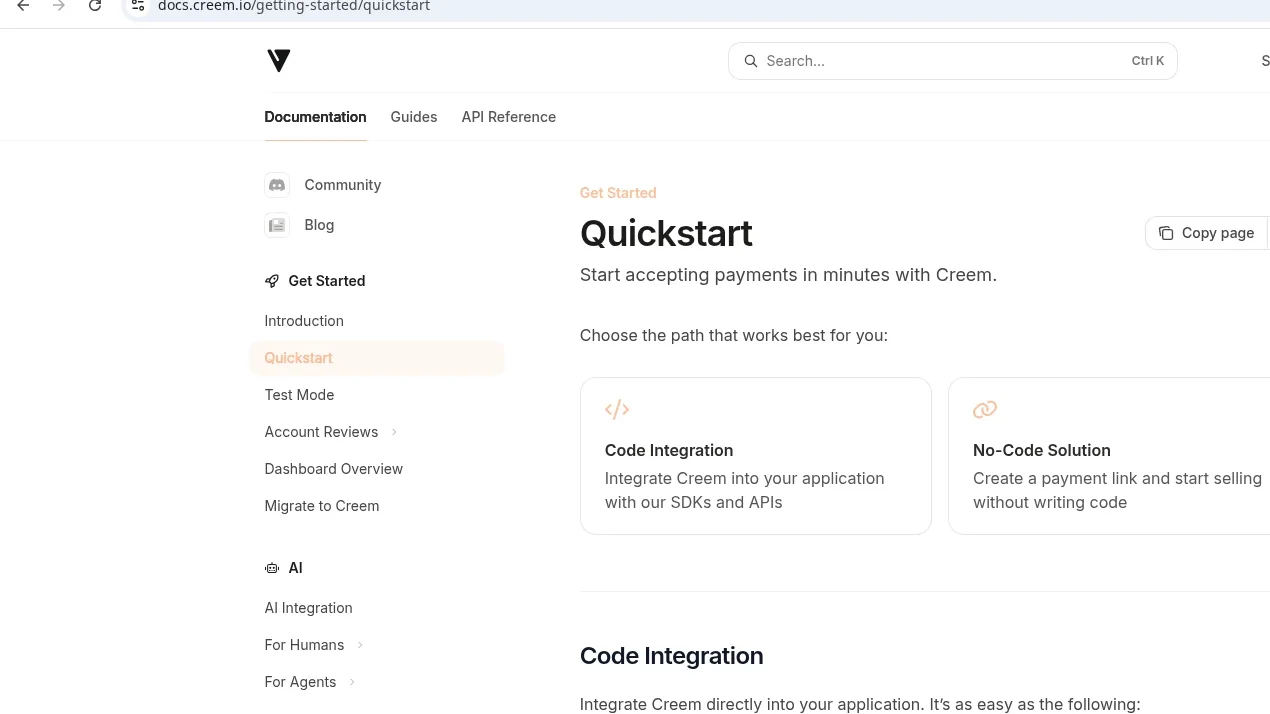
Figure 5: The quickstart offers a Code Integration path, using the SDKs and APIs, and a No-Code Solution built on payment links. Further down, the steps are: get an API key, create a checkout or product, and share the link. The sidebar also links to Test Mode and Account Reviews.
With no code, create a product in the dashboard and put its payment link behind your pricing button. Add webhooks when you need to sync subscription state. The sandbox API is test-api.creem.io and production is api.creem.io.
Step 6: Pass the review, complete KYC and add a payout account.
Under Balance → Payout Account, the flow runs: business details, KYC/KYB, payout account, Creem team review, then live payments. Reviews usually take 1–2 working days, or up to 3 at peak times. Common reasons for changes:
- A free subdomain such as
*.vercel.appor GitHub Pages instead of your own domain. - A support email that differs from the one on your site. Creem recommends a branded address.
- Missing legal pages, or fake reviews and inflated user counts on the site.
KYC needs a government-issued ID. Blurry photos, expired documents and name mismatches get rejected. The payout account must match your verified identity: personal (Alipay for individuals in China) or business.
Step 7: Request a payout.
Once your balance reaches US$50, the Withdraw button becomes active. Payouts run on the 1st and 15th, and each payment clears a 7–12 day risk hold before it can be paid out.
The caveats
- AI image and video products face a higher bar. Creem lists generative AI, such as text-to-image and text-to-video, as a restricted category. It asks for your previous processor, your chargeback and refund rates, why you are moving and an established track record. Once live, every image or video generation must pass Creem's Moderation API, at US$0.0003 per 1,000 characters. Paid generations must also run on Customer Credits. Product names can't borrow model brands, so a name like "VEO3Studio" is out.
- Prohibited outright: face-swap and deepfake tools, AI companion or romance chatbots, adult content, VPNs and proxies, resold accounts (including shared AI subscriptions), trading bots, engagement farming, third-party downloaders and crypto assets. API resellers and service businesses are restricted.
- Funds can be held. The terms allow Creem to withhold or freeze payouts for compliance checks, fraud investigations or chargeback reserves, for up to 90 days when another account linked to yours is under investigation. A rejection is final for that business.
- Other fees: US$25 per chargeback. Creem may refund buyers within 60 days. Splits and affiliates each add 2%, and abandoned-cart recovery adds 5%.
- Currencies and methods: you can price in USD or EUR only. Buyers can pay by card, Apple Pay or Google Pay. Alipay is available for one-time payments only.
- Your own tax is still yours. The terms ask merchants to be properly registered as a business or self-employed person under local law, and to pay income tax on payouts. Creem handles only the buyer-side consumption tax. Get local advice.
- USDC payouts can raise conversion and regulatory questions in mainland China. Weigh them carefully.
FAQ
### How can a solo developer in China get paid without a company? The simplest route is a merchant of record that onboards Chinese individuals, such as Creem or Paddle. It handles overseas consumption tax, and you sign up with personal ID verification. Stripe needs a business in a supported country.
### Can I open a Stripe account as an individual in mainland China? Mainland China is not on Stripe's supported list, but Hong Kong is. Mainland founders usually use a Hong Kong company or a US company formed through Stripe Atlas.
### Is Creem legitimate? Creem is operated by Armitage Labs OÜ, a company registered in Estonia. It lists China as a supported merchant country and offers Alipay payouts to individuals there. Your own registration and income tax still follow local rules.
### Can an individual use Creem, or do I need a company? You don't need a company. Natural persons can be merchants. Individuals complete KYC and are paid to Alipay; companies add KYB and use a business bank account.
### Does Creem support Alipay? Yes, both ways. For payouts, individuals in China can withdraw to Alipay, up to CNY 50,000 per payout and CNY 300,000–600,000 a year. For checkout, buyers can pay with Alipay, but only for one-time purchases.
### Creem vs Paddle vs Lemon Squeezy: which is cheaper? On standard list prices, Creem charges 3.9% + 40¢, Paddle 5% + 50¢ and Lemon Squeezy 5% + 50¢. Lemon Squeezy also adds surcharges for international, PayPal and subscription payments. Your real cost also depends on payout fees and FX.
### How often does Creem pay out? On the 1st and 15th of each month. You need a US$50 minimum balance, and each payment clears a 7–12 day risk hold first.
Bottom line
For a solo founder in China without a company, Stripe's barrier is the entity. PayPal will open an account, but it leaves overseas tax with you and takes several cuts on the way home. Creem solves all three problems in one place: individuals can apply, it remits overseas consumption tax, and payouts can go to Alipay. The trade-offs are the 3.9% + 40¢ fee, a strict review, and extra compliance work for AI image and video products. Build in test mode first, and get your domain, legal pages and support email ready before you submit for review.
Sources
- Creem pricing: https://www.creem.io/pricing
- Creem supported countries: https://docs.creem.io/merchant-of-record/supported-countries
- Creem payouts: https://docs.creem.io/merchant-of-record/finance/payouts
- Creem account reviews: https://docs.creem.io/merchant-of-record/account-reviews/account-reviews
- Creem merchant terms: https://www.creem.io/terms
- Stripe global availability: https://stripe.com/global
- Stripe Atlas: https://stripe.com/atlas
- PayPal mainland China merchant fees: https://www.paypal.com/c2/business/paypal-business-fees
- Paddle account verification: https://www.paddle.com/help/start/account-verification/what-is-account-verification
- Lemon Squeezy fees: https://docs.lemonsqueezy.com/help/getting-started/fees