
McKinsey raises 2030 semiconductor forecast 44% to $2.3 trillion
10/02/2026 — 10/03, 01:39·1 sources·1 reports
Story overview
McKinsey has raised its baseline forecast for the global semiconductor market in 2030 from $1.6 trillion to $2.3 trillion, an increase of about 44%, according to a report from Wallstreetcn dated October 2, 2026. The earlier figure dates to the fall of 2025. Over the same period, global wafer shipments are expected to keep growing at roughly 7% a year, essentially unchanged from the previous forecast. The implication, the report says, is that the added market value comes mainly from rising ASPs for advanced-node chips and memory rather than from higher shipment volumes.
AI infrastructure spending is described as the central driver. Five hyperscale cloud providers plan combined capital expenditure of about $800 billion in 2026, rising to $1 trillion in 2027, with the bulk going to AI infrastructure, which keeps pushing up demand and prices for advanced-node chips and memory.
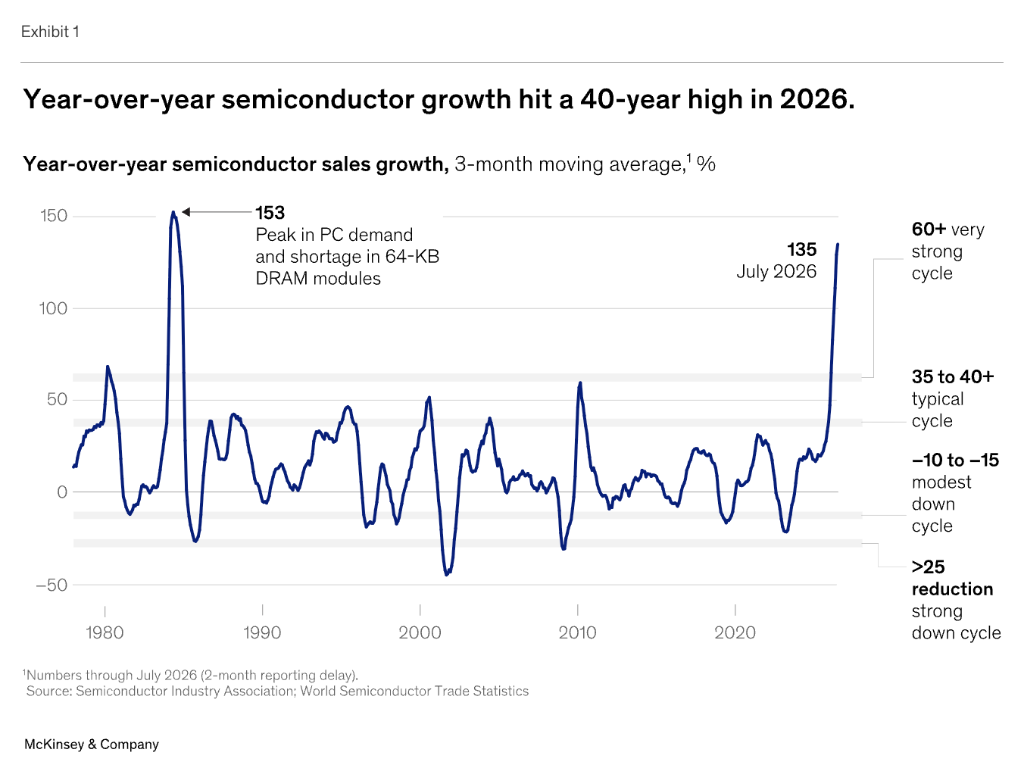
The report also notes that year-on-year growth in global semiconductor sales in the first half of 2026 was the highest since the mid-1980s, with July setting a 40-year high, and that global semiconductor market revenue soon afterward crossed $1 trillion for the first time. As of this report, matters rest at McKinsey's publication of the revised forecast; the material does not say whether McKinsey changed its shipment growth outlook, nor does it include any response to the forecast from other institutions.
AI-generated from 1 reports · updated 44 minutes ago
Latest turnMcKinsey lifted its 2030 baseline forecast for the global semiconductor market from $1.6 trillion to $2.3 trillion, a roughly 44% increase, while wafer shipment growth stays at about 7% a year. Most of the added value comes from rising ASPs for advanced-node chips and memory, driven by AI infrastructure spending.
- Heat index
- 77
- Sources
- 1
- Reports
- 1
- First seen
- 9 hours ago
Reports on this story headlines open the original
McKinsey lifted its 2030 baseline forecast for the global semiconductor market from $1.6 trillion to $2.3 trillion, a roughly 44% increase, while wafer shipment growth stays at about 7% a year. Most of the added value comes from rising ASPs for advanced-node chips and memory, driven by AI infrastructure spending.
华尔街见闻AI score 72
Other stories people are talking about
- 625SurgeNVIDIA launches 64GB DGX Spark desktop AI computer at $4,9997 sources
- 495RisingGoogle releases Gemini 4 Argon as next-gen frontier AI model14 sources
- 389NewApple tightens macOS Full Disk Access over AI agent risks4 sources
- 224SurgeMicrosoft AI releases MAI-Transcribe-2-Streaming real-time transcription model3 sources
- 191NewAnthropic launches Claude Frontier Academy with $100M2 sources
- 179NewHugging Face open-sources AstaBrief for fast report generation2 sources
How is heat calculated?About the methodHide
Heat counts how many independent sources covered a story in the last 48 hours: one source counts once no matter how many posts it published, decaying with a 24-hour half-life. What ranks first is what many people are talking about.
This page aggregates public feeds. Headlines and summaries are machine-organized and remain the property of the original authors; verify important facts at the source.
- Surge
- Discussion rising fast
- New
- First report within 6 hours
- Rising
- Still gathering discussion