
Overview
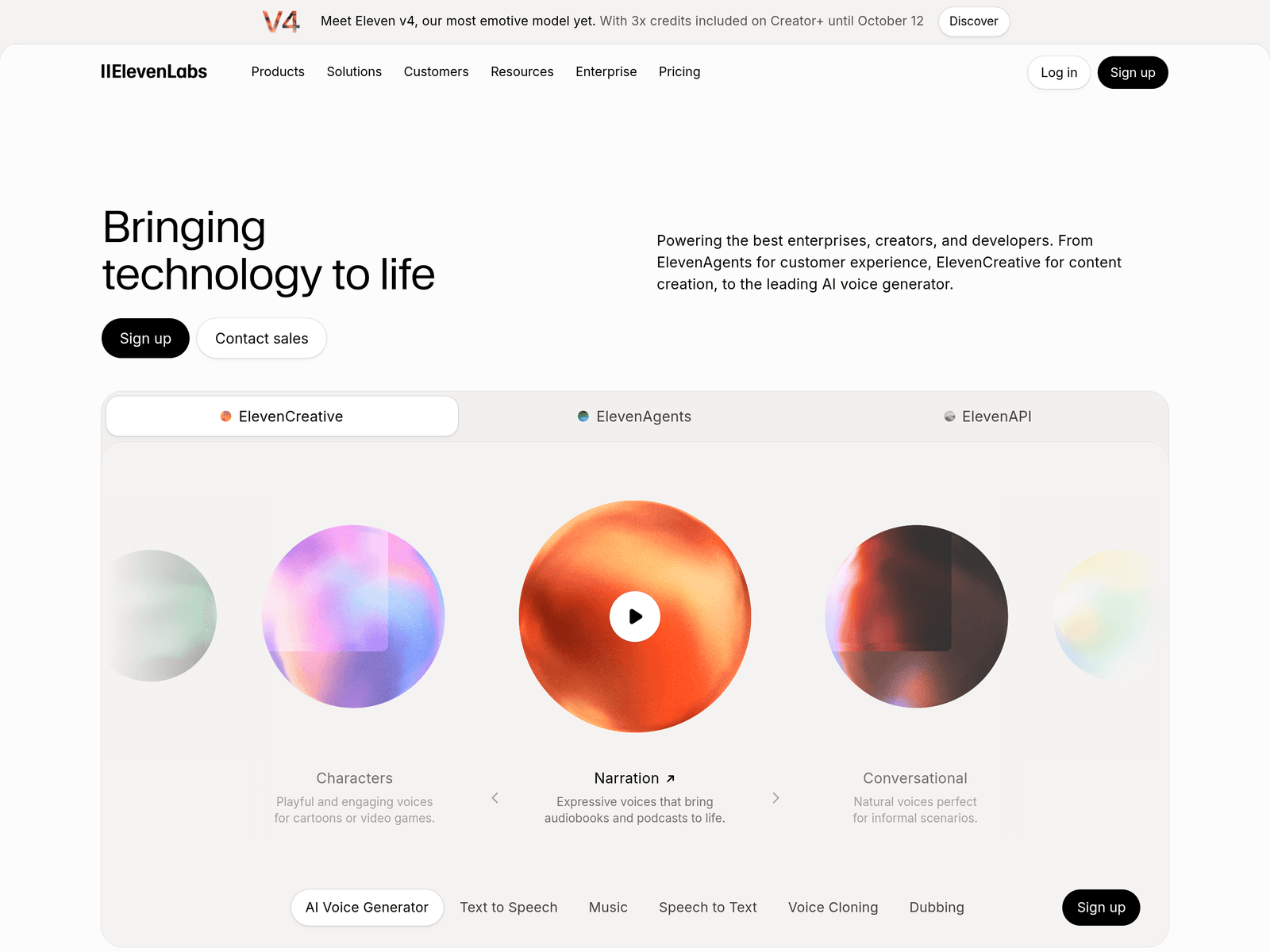
ElevenLabs combines AI voice generation, audio editing, and conversational voice agents in one product ecosystem. Its website describes two main platforms: ElevenCreative for creating speech, videos, music, and sound effects, and ElevenAgents for configuring, deploying, and monitoring conversational agents. The service is aimed at creators, developers, and enterprises that need narration, character voices, localized audio, or interactive voice experiences.
Key Uses
- Text-to-speech production: Convert scripts into playable speech for narration, advertisements, short videos, lessons, product explainers, and other content that needs fast voice output.
- Voice cloning and character voices: Generate voices for characters, storytelling, or brand narration, which can be useful for animation, games, audiobooks, and projects that need distinct vocal identities.
- Audiobooks and podcasts: Use the built-in audio editor to produce podcasts, audiobooks, and voiceovers, making it easier to turn long-form text into continuous and editable audio.
- Multilingual dubbing and localization: Generate speech in more than 70 languages, supporting cross-language distribution, foreign-language narration, advertising localization, and multilingual product explanations.
- Music and sound effects: In addition to speech, ElevenLabs can generate music and sound-effect material for short films, ads, games, and interactive content that needs atmosphere or audio cues.
- Conversational voice agents: ElevenAgents can be used to configure and deploy voice agents for customer support, inquiries, guided experiences, and voice-based question answering.
Who It Is For
- Creators and short-video teams: Creators can generate different voice styles for short videos, social media clips, and advertisements without arranging studio recording for every draft.
- Audiobook, podcast, and education producers: Publishers, podcast teams, and education creators can convert written material into spoken audio and adjust pacing, tone, and delivery through the editor.
- Game, animation, and narrative teams: Game and animation teams can produce different vocal styles for character dialogue, story narration, interactive fiction, or early voice prototyping.
- Developers and enterprises building voice experiences: Developers can use APIs and SDKs to add speech generation to apps, websites, customer-support systems, or voice agents built with ElevenAgents.
- Teams publishing in multiple languages: Organizations that distribute content across language markets can create narration, ads, or product-audio versions in different languages.
Tips for Best Results
- Choose a voice style before generating: ElevenLabs presents voice directions such as narration, conversational, social media, and character voices, so selecting a style first can make the output fit the content more closely.
- Split long scripts into sections: For audiobooks, podcasts, or long narration, generate content by chapter or paragraph so tone, pauses, and emotional delivery can be reviewed more easily.
- Test short samples before final export: For ads, courses, or brand narration, generate a short sample first to check voice, speed, and emotional tone before producing the full project.
- Review localized scripts separately: Although the platform supports more than 70 languages, sentence rhythm, punctuation, and spoken style differ by language, so native-language review is recommended before publishing.
- Check API and SDK details before integration: If ElevenLabs will be embedded into an app, support system, or voice agent, review the available interfaces, deployment steps, and usage limits before starting development.
Limitations
- Output quality depends on script quality: Missing punctuation, unclear sentence breaks, or weak emotional cues in the source text may affect how natural or expressive the generated speech sounds.
- Multilingual results should be verified per language: The platform supports many languages, but performance may vary by language, accent, voice, and model, so target-language samples should be tested before release.
- Voice cloning requires permission checks: When using voice cloning or specific voice assets, confirm that the necessary rights or permissions are in place, especially for commercial projects or third-party voices.
- Pricing and credits should be checked on the official page: The website mentions 3x credits included on Creator+ until October 12, but exact pricing, free limits, subscription benefits, and campaign terms should be confirmed on the official page.
Frequently Asked Questions
How do I start using ElevenLabs?
You can visit the ElevenLabs website, create an account, and enter the voice generation or creative workspace. The usual workflow is to enter text, choose a voice or style, preview the result, and export the audio. Developers can also explore the API and SDK documentation for integration.
Is ElevenLabs free to use?
The website uses the phrase Free AI Voice Generator, indicating that there is a free voice-generation entry point. However, the exact free quota, voice availability, export limits, and paid plan details should be checked on the official page after signing in.
Which languages does ElevenLabs support?
ElevenLabs supports speech generation in more than 70 languages, including Chinese. Available voices, styles, and features may differ by language, so it is best to generate a short sample in the target language before using it in a finished project.
How is ElevenLabs different from a basic TTS tool?
ElevenLabs goes beyond basic text-to-speech by emphasizing ultra-realistic speech, voice cloning, dubbing, music, sound effects, and voice agents. It is more suitable for character voices, multilingual narration, and interactive voice applications than simple robotic TTS output.
Can ElevenLabs be used in apps or customer-service systems?
Yes, ElevenLabs provides APIs and SDKs for adding speech generation to applications, websites, customer-support systems, and conversational products. ElevenAgents can also be used to configure, deploy, and monitor voice agents, though exact capabilities should be confirmed in the official documentation.