
Overview
- Tool name: OpenRouter
- Developer: OpenRouter, Inc
- Official website: https://openrouter.ai/
- Category: AI Platforms
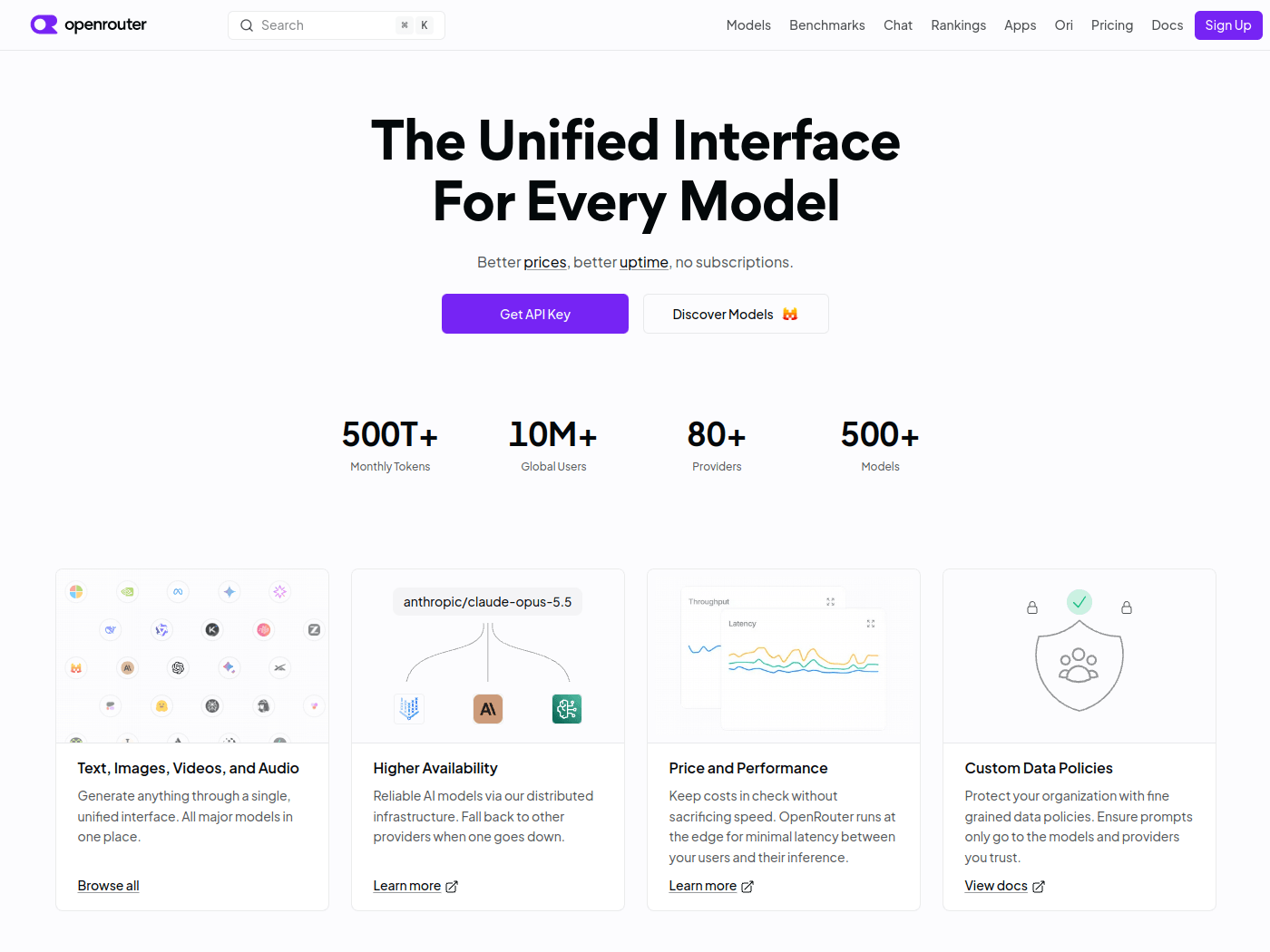
OpenRouter is an AI model API aggregation platform with a unified interface for multiple model providers. It helps developers access text, image, video, and audio models without building separate integrations.
Key Uses
- Call multiple models through one interface: OpenRouter provides a unified API for models from different providers, reducing the need to maintain separate keys, SDKs, and request formats.
- Compare models and pricing: The platform includes model listings, rankings, and benchmark pages, helping teams evaluate candidates before committing to a model.
- Build multimodal applications: The site describes access to text, image, video, and audio generation through a single interface, which can support mixed-modality products.
- Apply organization-level data policies: OpenRouter mentions fine-grained data policies that can restrict prompts to trusted models or providers.
- Use an OpenAI-compatible API: The platform states that its API is fully OpenAI compatible, which may simplify adoption for projects already using OpenAI-style requests.
- Explore agents and app examples: Featured agents and app examples can help developers understand how other teams combine models, agents, and workflows.
Who It Is For
- Developers prototyping AI features: Teams that need to test several large models quickly can use OpenRouter to compare output quality, latency, and cost.
- Products needing model fallback: If one provider becomes unavailable, the platform’s distributed infrastructure can help route requests to alternative providers.
- Teams evaluating multimodal models: Users comparing text, image, video, or audio models can use the catalog, rankings, and benchmark pages during selection.
- Organizations centralizing model access: Teams that want one place to manage API keys, credits, and data policies may use OpenRouter as a shared access layer.
- Builders of agents and content pipelines: Blog topics such as image-to-video models, embedding models, and moderation workflows suggest relevance for agent and content-generation projects.
Tips for Best Results
- Review the model catalog first: Check the number of models, providers, rankings, and benchmark pages before selecting models for production testing.
- Start with small credit purchases: The site mentions buying credits that can be used with any model or provider, so small tests can validate quality and stability first.
- Configure fallback candidates: Because provider availability can change, critical workflows should include alternative models and clear fallback logic.
- Set data policies before sending sensitive prompts: If prompts contain confidential information, use fine-grained policies to limit which models or providers may receive them.
- Test latency with your own users: The platform mentions edge operation for lower latency, but real-world performance should still be tested across target regions.
Limitations
- Dependence on upstream providers: OpenRouter aggregates third-party model services, so availability, rate limits, and compliance terms may still depend on each provider.
- Catalog and pricing can change: The models, providers, and credit information shown at the time of review may not remain the same, so current listings should be checked before integration.
- Multimodal support varies by model: Although the platform covers text, image, video, and audio, individual models may differ in resolution, control options, input formats, and pricing.
- Compliance requires independent review: Data policies can control where prompts are sent, but teams must still assess whether the setup meets their own legal and industry requirements.
Frequently Asked Questions
How do I start using OpenRouter?
The site describes signing up, buying credits, and creating an API key. After the key is created, developers can begin making requests through the platform’s OpenAI-compatible API.
Does OpenRouter offer a free tier?
The provided information does not confirm a free tier. The platform shows a credit purchase flow, and credits can be used with any model or provider, so current pricing should be checked directly.
What models and providers does OpenRouter support?
The site mentions more than 500 models and more than 80 providers, covering text, image, video, and audio capabilities. The exact catalog and pricing may change over time.
How is OpenRouter different from using a single model API directly?
A single model API usually connects to one provider, while OpenRouter aggregates multiple providers behind one interface. This makes it easier to compare models, manage costs, and switch providers when needed.
Who should consider OpenRouter?
It is suitable for developers and teams that need access to multiple AI models, want to compare pricing or performance, or need a centralized way to manage model access and data policies.