
Overview
- Tool name: Llama 3
- Official website: https://llama.meta.com/llama3/
- Category: AI Models
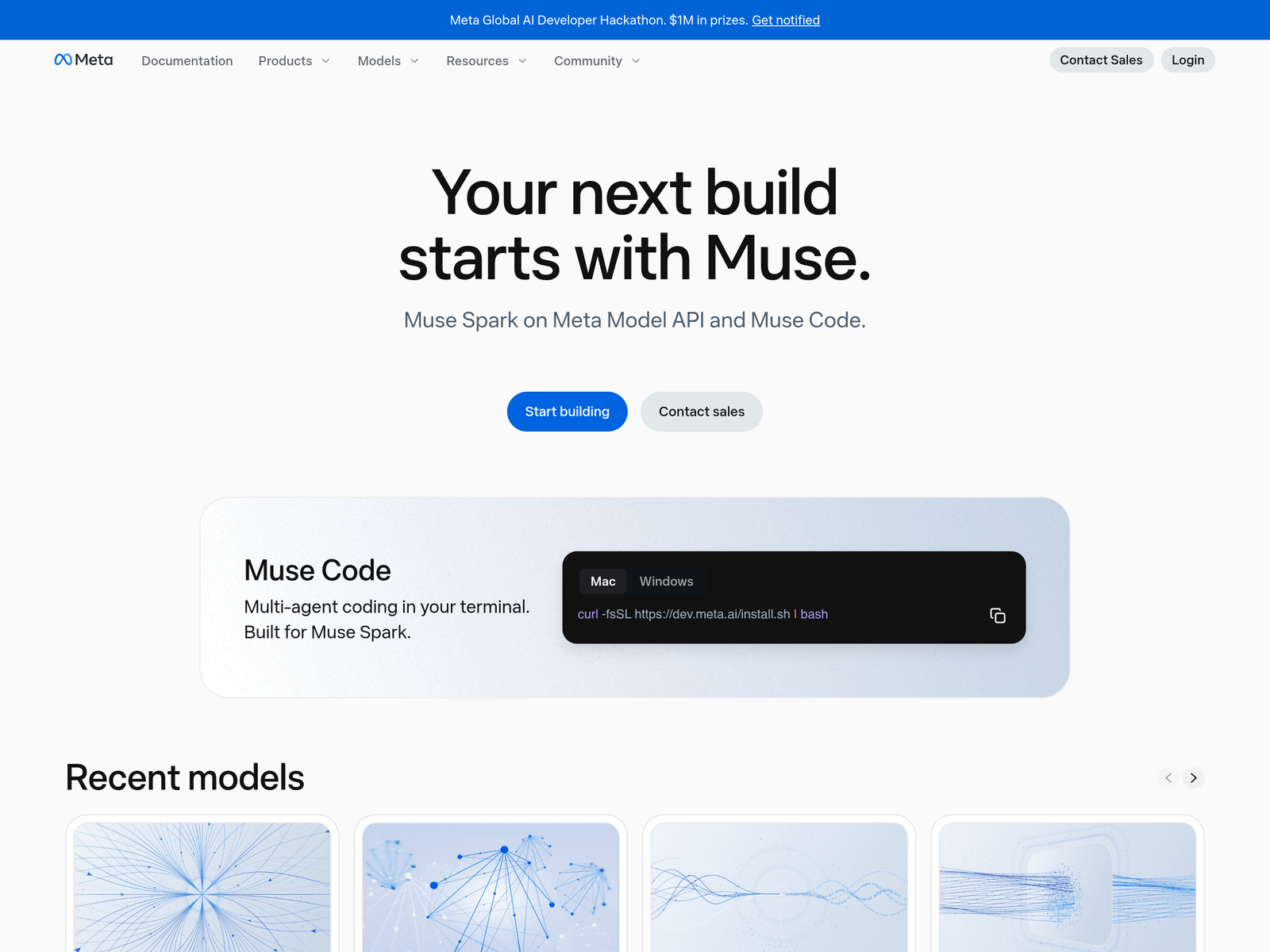
Llama 3 is Meta's open-source large model for text, code, reasoning, and multimodal tasks. It helps developers build assistants, agents, and workflow tools. The model can be used through APIs, open downloads, or ecosystem integrations.
Key Uses
- Text generation and rewriting: Llama 3 can draft documents, summaries, emails, marketing copy, and knowledge notes. It can also rewrite, shorten, or polish existing text for clearer communication and faster content production.
- Reasoning and problem decomposition: The model can break complex questions into intermediate steps, making it useful for analysis, comparison, tutoring, planning, and workflows that require structured reasoning rather than a single direct answer.
- Coding assistance: Llama 3 can generate code snippets, explain functions, complete logic, locate common errors, and translate natural-language requirements into runnable code, supporting developers in everyday engineering and automation tasks.
- Multimodal understanding: It can interpret images, screenshots, documents, and visual materials, helping extract information, explain interfaces, produce structured outputs, and support multimodal agents that combine perception with action.
- Agent and workflow orchestration: The model can serve as the reasoning core of an agent, handling task planning, context tracking, tool use, and multi-step execution for automated assistants, research pipelines, and business workflows.
- Local and private experimentation: Open weights allow teams to download and run the model in local or private environments, which is useful for offline testing, fine-tuning, custom inference stacks, and controlled data handling.
Who It Is For
- Developers building AI products: Engineers can integrate Llama 3 into chatbots, search tools, knowledge assistants, content apps, and automation products through APIs, local deployment, or third-party platforms.
- Teams handling documents and knowledge: Operations, support, research, and knowledge-management teams can use it for summarization, meeting notes, ticket classification, structured extraction, and internal information retrieval.
- Content creators and editors: Writers, marketers, product teams, and social media managers can generate drafts, headlines, scripts, multilingual content, and variations before human review and publication.
- Software engineering teams: Developers can use the model for code explanation, test generation, debugging assistance, script writing, and agentic coding workflows that connect planning with execution.
- Researchers and educators: The model is suitable for prompt-engineering experiments, fine-tuning tests, benchmark comparisons, classroom projects, and evaluations of open-weight models across specific tasks.
- Multimodal prototype builders: Teams working with screenshots, documents, charts, forms, or interface understanding can use Llama 3 to build early prototypes that combine visual input with structured reasoning.
Tips for Best Results
- Define the task clearly: Separate text generation, coding, reasoning, and multimodal understanding before choosing prompts, context length, and output formats, because each task type has different requirements.
- Structure long inputs and outputs: For documents, multi-turn conversations, or complex workflows, organize the input and ask for step-by-step answers, lists, or JSON output so results are easier to parse and verify.
- Combine retrieval and tools: When the task depends on current information, private data, or external systems, connect the model to search, databases, APIs, or code execution instead of relying only on internal knowledge.
- Validate with real samples: Before production use, test accuracy, stability, latency, and cost on real business cases, and add human review for high-risk outputs such as legal, medical, financial, or safety-related content.
- Review licensing and compliance: Open-weight models are subject to license terms, deployment rules, and data policies. Organizations should confirm permitted use, commercial conditions, and security requirements before integration.
Limitations
- Outputs need verification: The model may produce plausible but inaccurate statements. High-risk domains such as law, medicine, finance, and safety require expert review before publication or action.
- Real-time data requires integration: Llama 3 may not directly access live websites, private databases, or external systems. Retrieval, APIs, or tool calling may be needed for up-to-date information.
- Bias and instability are possible: Generated content can reflect training-data bias, inappropriate tone, or unstable formatting. Production systems should include filtering, moderation, and fallback mechanisms.
- Deployment can be resource-intensive: Running open-weight models locally may require GPUs, storage, inference frameworks, and optimization work. Teams should evaluate hardware and operational costs carefully.
- Multimodal quality depends on input: Image, screenshot, and document understanding can be affected by resolution, layout, language, and prompt design. Complex materials should be processed step by step.
Frequently Asked Questions
How do I start using Llama 3?
Start by reviewing the official website for model versions, licensing, and integration options. Developers can choose APIs, open-weight downloads, or supported ecosystem platforms. It is best to test small tasks first before moving into production.
Is Llama 3 free to use?
Open weights may be available under the official license, but total cost depends on how the model is used. API calls, cloud hosting, inference hardware, and third-party platforms may create separate charges. Pricing should be checked with the official source or provider.
What platforms and languages does Llama 3 support?
Llama 3 can be used for text, code, reasoning, and multimodal tasks through APIs, local deployment, or open-source ecosystems. Supported languages, model sizes, context limits, and platform compatibility should be confirmed in official documentation and model cards.
How is Llama 3 different from other open-source large models?
Llama 3 is positioned within Meta's broader open model ecosystem and developer tooling. It may suit teams that want open weights, API access, fine-tuning, and multimodal experimentation. The best choice still depends on task performance, licensing, budget, and infrastructure.
Are there alternatives to Llama 3?
Yes. Teams can compare other open-weight foundation models, hosted APIs, or third-party model platforms. The right alternative depends on whether the priority is cost, privacy, deployment control, multilingual support, coding ability, or multimodal performance.