
Overview
- Tool name: Semantic Scholar
- Developer: Ai2
- Official website: https://www.semanticscholar.org/
- Category: AI Search
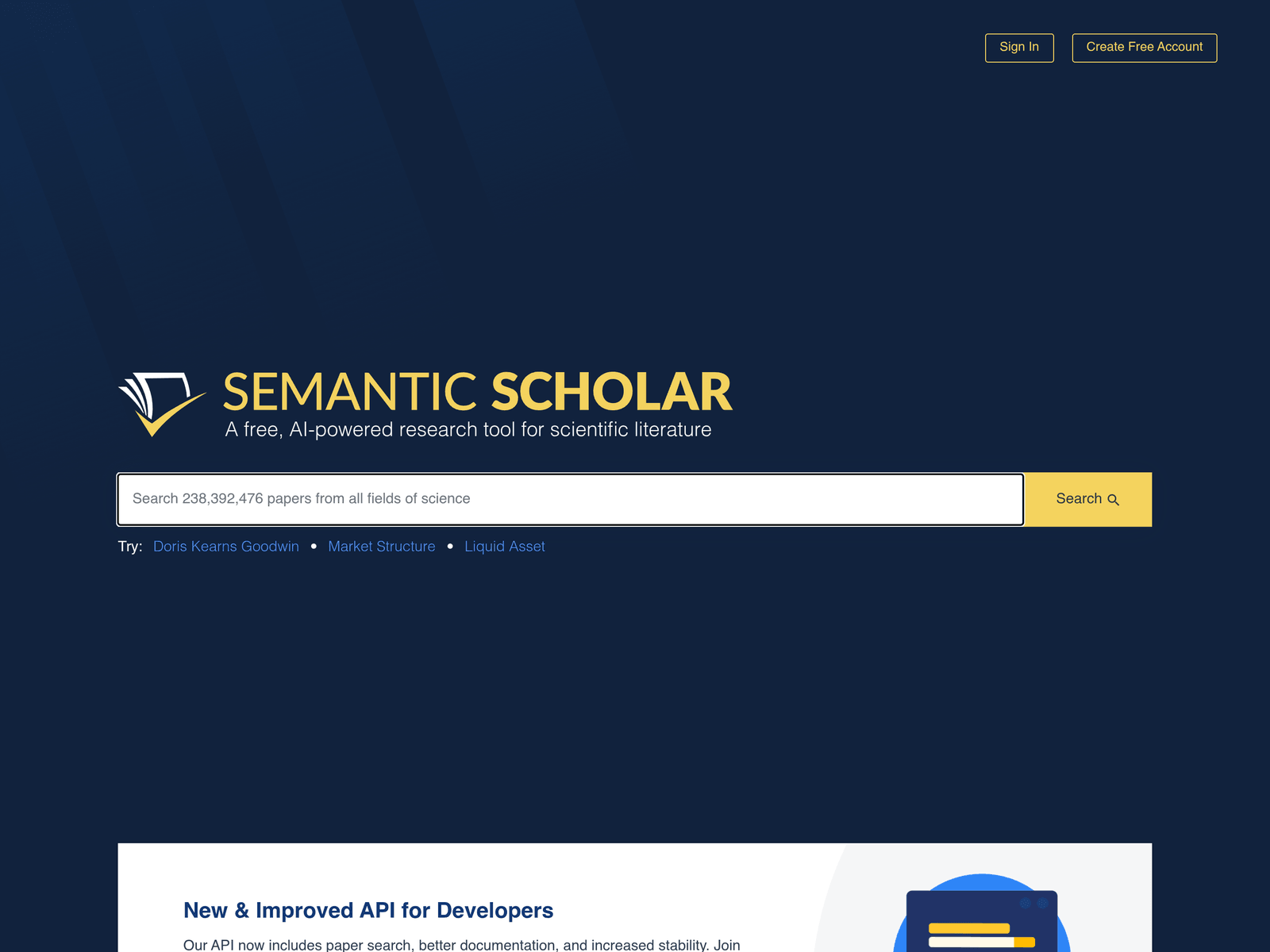
Semantic Scholar is a free AI academic search tool built by Ai2 for scientific literature. It helps researchers discover relevant papers through semantic search, citation graphs, and paper recommendations.
Key Uses
- Search scientific literature across fields: Semantic Scholar indexes about 238 million papers from many scientific fields, making it useful for early-stage literature discovery and broad topic exploration.
- Explore citation connections: Its citation graph helps users see how papers relate to one another, which can support judgment about influence, context, and research lineage.
- Find related paper recommendations: While reading or evaluating a paper, users can use recommendations to uncover adjacent work that may not appear in a first keyword search.
- Build scholarly applications with the API: The Semantic Scholar API provides paper search and related capabilities for developers who want to integrate academic discovery into their own tools.
- Read selected papers with richer context: Semantic Reader, currently in beta, offers an augmented reading experience for select papers and may help readers understand scientific text more easily.
Who It Is For
- Researchers conducting literature reviews: Academic researchers can use it to locate relevant publications, compare related work, and identify gaps before drafting a paper or proposal.
- Students starting a new research topic: Students can use search and recommendation features to build an initial reading list and understand how a topic is discussed across papers.
- Developers building research tools: The API is relevant for developers creating scholarly apps, citation analysis workflows, or literature discovery features.
- Teams tracking scientific developments: Organizations or labs monitoring a field can use it to follow new publications and see how research conversations evolve.
Tips for Best Results
- Start with precise research terms: Use specific concepts from your topic rather than very broad words, then expand with synonyms if the first results are too narrow.
- Use citation context, not just titles: Check how a paper is connected to other work before deciding whether it is central to your question or only superficially related.
- Treat recommendations as discovery aids: Recommended papers can surface useful leads, but verify methods, claims, and citations in the original source before relying on them.
- Review API documentation before integration: Developers should confirm available endpoints, stability expectations, and usage terms before building production features on the API.
Limitations
- Semantic Reader is still in beta: The enhanced reading experience is available only for select papers, so coverage and functionality may vary across the corpus.
- AI-assisted discovery still needs human review: Semantic Scholar can improve search efficiency, but users remain responsible for evaluating paper quality, methodology, and citation accuracy.
- API coverage may not match every site feature: The API includes paper search and related capabilities, but not every interface feature should be assumed to be available through programmatic access.
Frequently Asked Questions
How do I start using Semantic Scholar?
Visit the official website and enter a paper title, author, topic, or keyword in the search box. You can begin exploring results without setting up a complex workflow.
Is Semantic Scholar free to use?
The service is described as a free AI-powered research tool for scientific literature. For API access or beta features, users should review the relevant terms and documentation.
How is it different from traditional academic databases?
Traditional databases often emphasize indexed records and field-based search, while Semantic Scholar focuses on AI-assisted semantic understanding, citation graphs, and recommendations. It is especially useful for discovery, though original papers still need careful review.
Who should use the Semantic Scholar API?
The API is intended for developers and teams that want to embed academic search into applications, dashboards, or research workflows. They should read the API documentation first to understand supported capabilities and limits.
Does Semantic Reader work on every paper?
Semantic Reader is in beta and is available for select papers, according to the official site. Availability may differ by paper, so users should check whether a specific item supports the feature.