
Overview
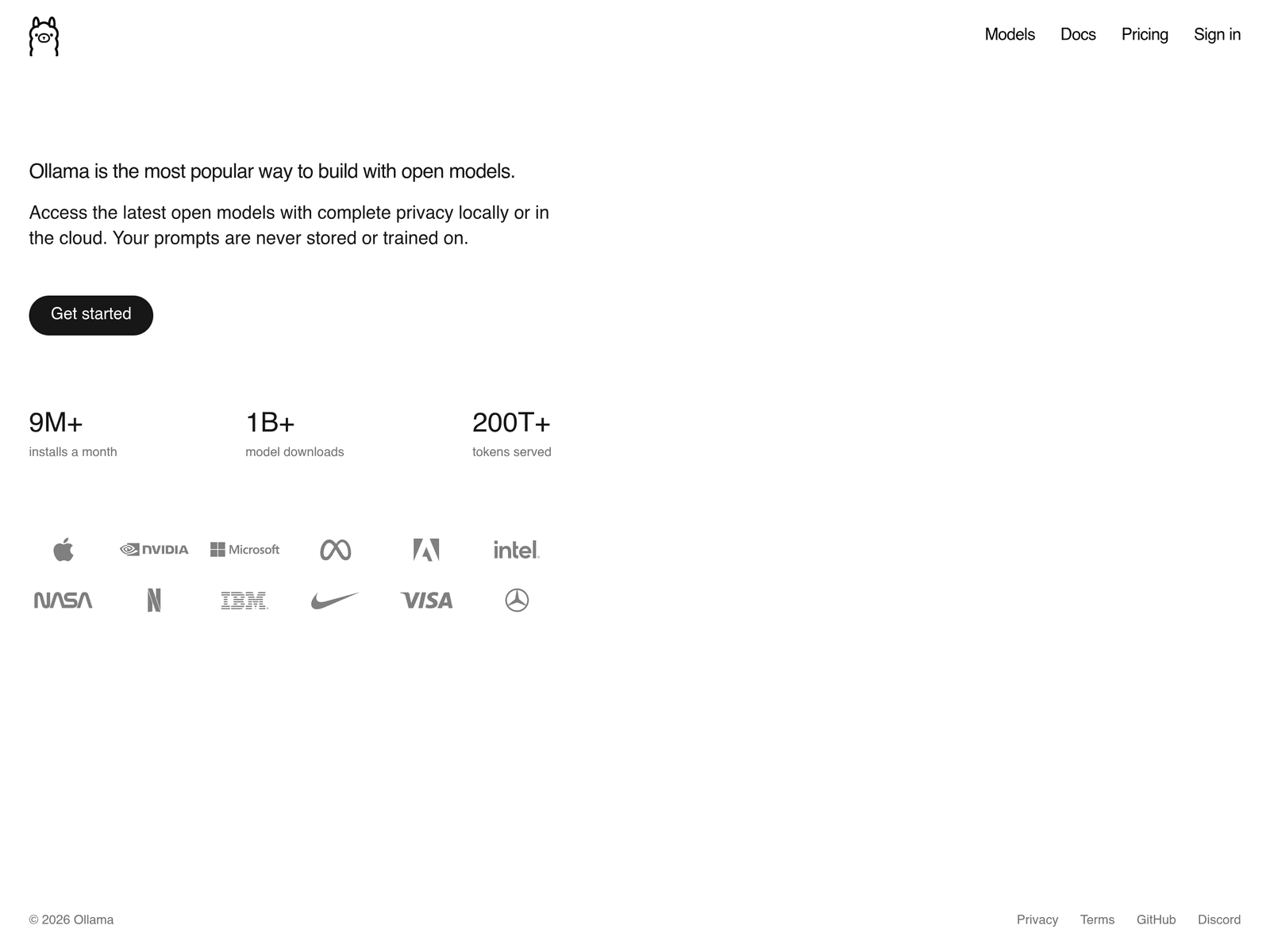
Ollama positions itself as a way to build with open models. Its homepage describes it as an API for open models and says users can get inference locally or in the cloud, anywhere they already work. The page also provides access to Models, Docs, and Pricing, which suggests it serves both as a model catalog and as an inference layer.
The homepage lists three usage figures: more than 9M monthly installs, more than 1B model downloads, and more than 200T tokens served. These numbers indicate broad adoption, but the source material does not explain how they are measured. Ollama is best understood as an access and runtime layer for open models rather than a single standalone model.
Key Uses
- Run open large language models locally: Ollama lets users run Llama and other open language models on their own machines, which is useful when prompts should remain on local infrastructure.
- Use cloud inference when local hardware is limited: Ollama also supports inference in the cloud, giving users an option when local compute is insufficient or when they need access from different environments.
- Access the latest open models through one entry point: The homepage refers to accessing the latest open models, making Ollama a catalog-style starting point for discovering and using open model options.
- Build applications on top of open models: Ollama describes itself as an API for open models, so developers can use it as a base layer for apps, internal tools, or workflows that need model inference.
- Support privacy-sensitive workflows: Because Ollama states that prompts are never stored or trained on, it can be relevant for users who want more control over prompt data than typical hosted services may provide.
- Distribute and download models: The homepage highlights model downloads as a major usage metric, indicating that Ollama also functions as a distribution path for model files.
- Serve ongoing token inference workloads: The reference to tokens served suggests Ollama can support repeated inference requests, not just one-off local experimentation.
Who It Is For
- Developers building with open models: Developers who want to integrate open models into products, prototypes, or internal tools can use Ollama as an access point.
- Teams that need private inference: Organizations that want to keep prompts within local or controlled environments may find Ollama’s local and privacy-focused positioning useful.
- Researchers evaluating open models: People comparing different open models can use Ollama to access multiple models through a shared workflow.
- Users with mixed local and cloud needs: Teams that sometimes need local privacy and sometimes need cloud availability can consider Ollama for both inference modes.
- Builders who prefer open model ecosystems: Users who want to avoid dependence on a single closed model provider may use Ollama to work with open models instead.
Tips for Best Results
- Check hardware requirements before local use: Running large language models locally can require substantial compute, memory, and storage, so users should confirm whether their machine can handle the target model.
- Start with the Docs and Models pages: The official site provides Docs and Models sections, which are the best places to confirm setup steps, supported models, and usage details before choosing a model.
- Match deployment mode to privacy needs: If prompt confidentiality is the priority, local inference may be preferable. If device resources are limited, cloud inference may be more practical.
- Review each model’s license and capabilities: Ollama provides access to open models, but individual models may have different licenses, strengths, and limitations, so each model should be reviewed separately.
- Confirm pricing on the official Pricing page: The homepage includes a Pricing link, but the provided material does not list specific costs or free allowances, so billing details should be checked directly on the official site.
- Treat usage statistics as scale signals, not performance guarantees: Install counts, downloads, and tokens served show adoption scale, but they do not prove results for any specific task.
Limitations
- Output quality depends on the selected model: Ollama is a way to access and run open models, so results vary by model family, size, and task suitability.
- Local performance may be hardware-dependent: Large models can be slow or impractical on lower-spec machines, and the available model range may be limited by local resources.
- Pricing and free-tier details are not confirmed in the provided material: The homepage shows a Pricing link but no specific pricing, so costs and free options should be verified officially.
- Privacy claims should be read alongside deployment mode: Ollama states prompts are not stored or trained on, but users should still review how local setups, cloud inference, and individual model terms apply in practice.
- Model licensing remains the user’s responsibility: Open models may carry different usage rights, so commercial use or redistribution should be checked against each model’s license.
Frequently Asked Questions
How do I get started with Ollama?
Start from the official Ollama website and review the Models and Docs sections. Those pages should explain how to choose a model and begin local or cloud inference. Since the current source material does not provide exact setup commands, the official documentation should be treated as the authoritative guide.
Is Ollama free to use?
The homepage includes a Pricing link, which suggests there may be different usage tiers or paid options, but the source material does not state exact prices or free allowances. Any conclusion about cost should therefore be based on the official Pricing page.
What platforms does Ollama support?
Ollama says inference can run locally or in the cloud, and that it works where users already work. However, the provided material does not list specific operating systems, devices, or cloud platforms, so platform support should be confirmed through official documentation.
How is Ollama different from a closed-model API?
Ollama focuses on open models and offers both local and cloud inference, while many closed-model APIs are tied to one provider’s hosted models. Ollama’s main distinction is its role as an access layer for open models, though the best choice depends on the model, deployment needs, and privacy requirements.
Are there alternatives to Ollama?
Yes. Users who only need a hosted closed model may use that model provider’s API directly, while users who want to self-host open models may also consider other runtimes or inference frameworks. The right alternative depends on hardware, model support, privacy needs, and deployment preferences.