
Overview
- Tool name: Tencent Hunyuan
- Developer: Tencent
- Official website: https://hunyuan.tencent.com/
- Category: AI Models
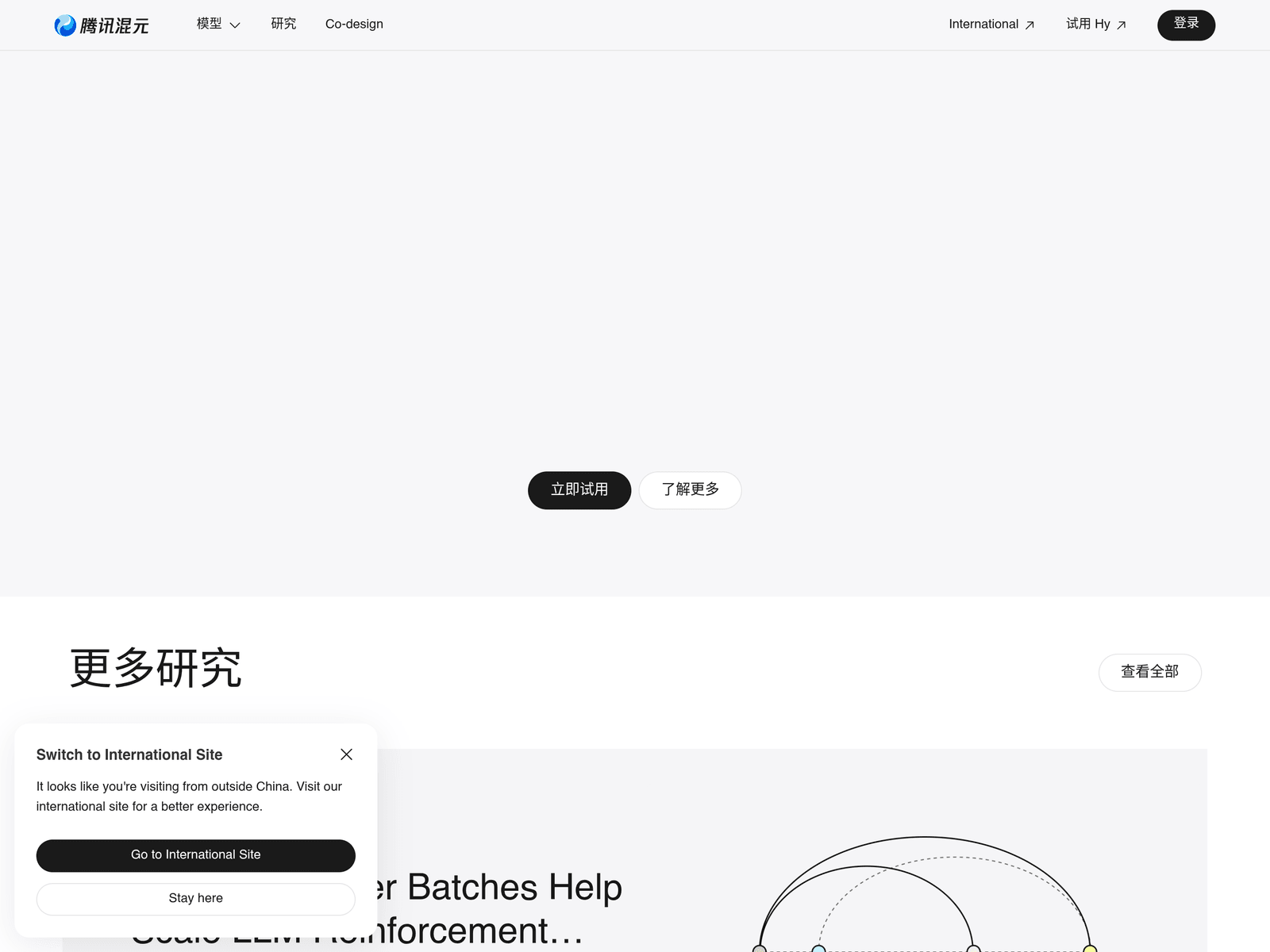
Tencent Hunyuan is a family of AI models from Tencent. The family spans language, vision, image generation and speech recognition. Several models can be tried from the official site, and the site shows how they are used in Tencent Docs workflows.
Key Uses
- Chinese writing and long documents: Hy3 supports a 256K context window, so it can be used for understanding, summarizing and drafting from lengthy source material.
- Coding assistance: Tencent describes Hy3 as having substantially strengthened code ability, useful for writing, reading and asking questions about a codebase.
- Reasoning: Hy3 offers three thinking modes, letting users trade speed against deeper step-by-step reasoning depending on the task.
- Image understanding: Hy Vision 2.0 is built on HY-2.0 LLM and targets general image-to-text scenarios such as describing or extracting content from pictures.
- Image generation: Hy Image3.5 preview is presented as having strong text rendering and a wide range of visual styles.
- Speech recognition: Hy ASR 3.0 preview builds on the Hy3 base model and combines transcription with semantic understanding, including dialect coverage.
- Document workflows: inside Tencent Docs, the model is applied to turning source material into an editable first draft rather than acting only as a general writing assistant.
Who It Is For
- Teams building Chinese-language products that need a model tuned for Chinese content.
- Developers who want code help and agent-style, multi-step task execution in the same family.
- Content and design teams producing visuals that must contain accurate rendered text.
- Organizations that need audio transcription paired with downstream semantic understanding.
- Groups already using Tencent office products, where the models are embedded in existing document flows.
Tips for Best Results
- Start from the trial entries on the official site and test each model type separately before committing to one.
- Match the thinking mode to the job: use the faster setting for simple rewriting and a deeper setting for multi-step reasoning or code.
- When working with long material, place related documents in a single pass to make use of the 256K context instead of feeding them piece by piece.
- Keep preview models such as Hy Image3.5 preview and Hy ASR 3.0 preview in non-critical flows until you have validated their output on your own data.
- Check the open-source model listing and the Co-design research section to see which capabilities are published and which remain experimental.
Limitations
- Hy Image3.5 preview and Hy ASR 3.0 preview are labeled as preview releases, so their capabilities and interfaces may still change.
- The official site does not publish pricing or free-quota details; check the site or console for current terms.
- Performance figures such as 295B/21B MoE and 256K context describe the model architecture, and real results vary by task and data.
- Model openness differs across the family, and an international site is offered, so available models and features may vary by region.
Frequently Asked Questions
How do I start using Tencent Hunyuan?
The official site lists models such as Hy3, Hy Vision 2.0, Hy Image3.5 preview and Hy ASR 3.0 preview, each with a trial entry. A practical first step is to run Hy3 on a piece of your own material and check whether the output fits your needs before planning any integration. Details on access methods are best confirmed on the individual model pages.
Is Tencent Hunyuan free to use?
The homepage does not publish prices or a free quota, and it does not state whether trial access is free or how usage is counted. Current terms are best confirmed on the official site or console. Until pricing is documented, avoid budgeting on the assumption of long-term free use.
What languages and platforms does it support?
Chinese content creation is the direction Tencent highlights, and Hy3 covers a 256K context plus code, long-form writing, reasoning and agent execution. On the speech side, Hy ASR 3.0 preview mentions dialect coverage. A complete language list and platform support are not laid out on the homepage, so check the relevant model pages.
How is it different from other model families?
Tencent positions the family around Chinese writing, long documents and code ability, and it also ships vision, image generation and speech models alongside the language model. Hy3 uses a 295B/21B MoE architecture with a 256K context and three thinking modes. No third-party comparison data is published on the site, so differences are best judged with your own tasks.
Are there alternatives to Tencent Hunyuan?
If you only need one capability, you can pick a language, image or speech service from other vendors separately. Hunyuan's distinguishing point is offering language, vision and speech models within one family, plus integration with Tencent office products. Whether to switch depends on how much you rely on Chinese writing, long context and document workflows.