
Overview
- Tool name: Genspark
- Developer: MainFunc
- Official website: https://www.genspark.ai/
- Category: AI Agents
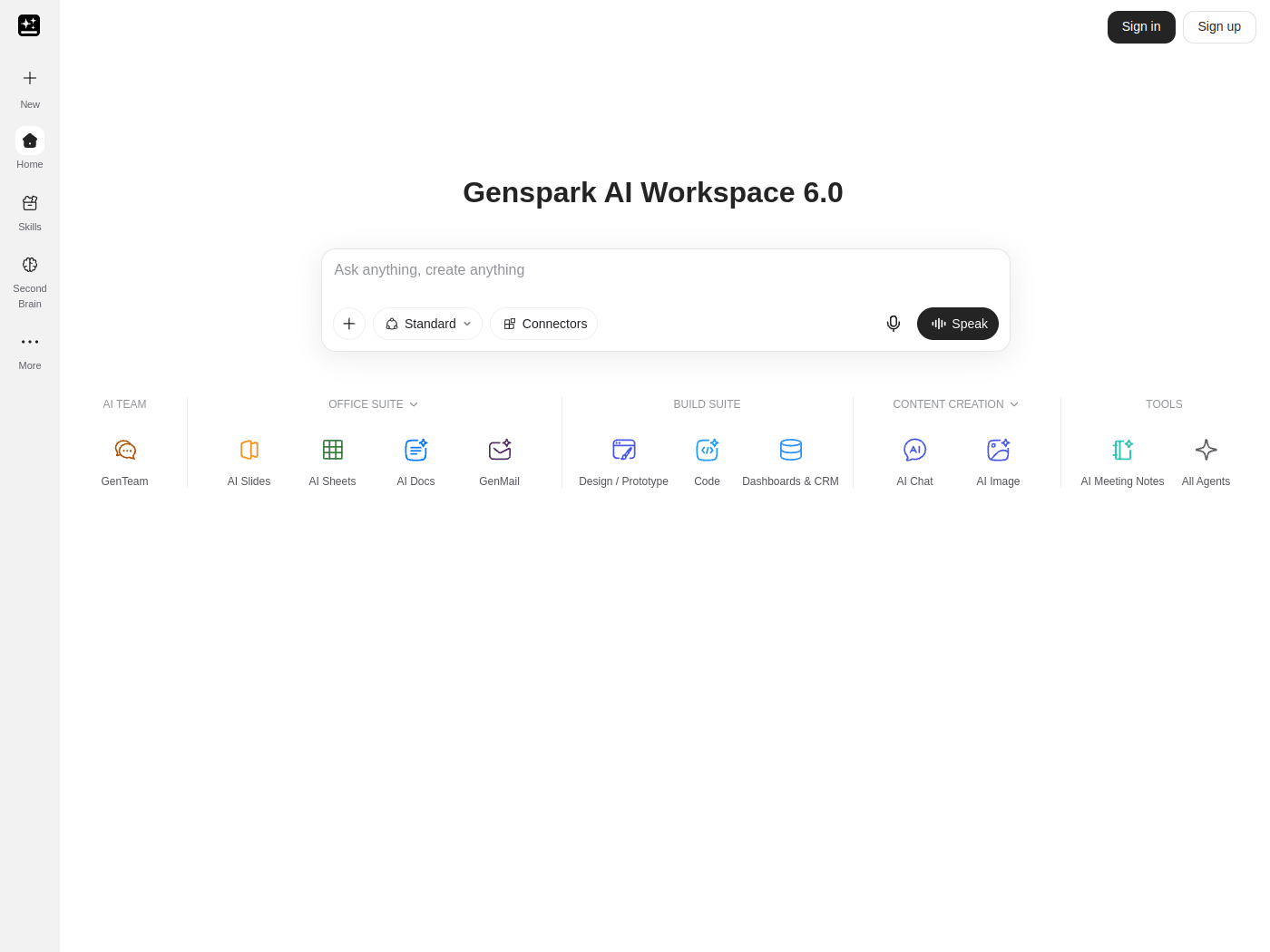
Genspark is an all-in-one AI agent workspace built by MainFunc, founded by former Baidu and Google executives. Instead of routing every request to one model, its Super Agent uses a Mixture-of-Agents design: it splits a task into steps, sends each step to whichever model or tool handles it best, then runs a reflection pass to combine the strongest parts. From a single prompt it can produce a cited research report (its signature Sparkpages), a slide deck, a spreadsheet, a document, images, or video — and it can place real phone calls on your behalf.
Key Uses
- Research that you can actually audit: Sparkpages pull from dozens of live sources and keep citations attached, so you can check any claim instead of trusting a summary you cannot inspect.
- Decks, documents and spreadsheets from one prompt: Ask for a client presentation, a data-backed sheet, or a drafted document and get a finished artifact rather than a block of text to reformat.
- Autonomous phone calls: The agent can call a business to book a table, confirm availability, or gather information, then return a recording and a summary — the most distinctive feature in the product.
- Consolidating several AI subscriptions: Frontier chat and image models from multiple providers sit behind one plan, which is the main argument for Genspark if you are currently paying for two or three tools.
- Building lightweight internal tools: AgentBase can assemble a simple CRM, dashboard, or tracker from your own data without a developer, aimed at teams that cannot justify an engineering ticket.
Pricing
- Free: no credit card required, with a daily credit allowance that resets every 24 hours and basic Super Agent access. Enough to test whether the research output fits your work.
- Plus: about $25 per month (less when billed annually), with a monthly credit allowance in the tens of thousands, more storage, and access to the full model and tool library.
- Pro: roughly $250 per month, multiplying the credit allowance and adding storage and early access to beta features.
- Team and Enterprise: per-seat and custom pricing with shared credit pools and admin controls.
Every task beyond core chat and image generation draws from one shared credit pool, and unused credits do not roll over. Prices and allowances change often — check genspark.ai for current figures.
Who It Is For
- Consultants and analysts: Research-heavy work where a cited, shareable output matters more than raw speed.
- Marketing and content teams: Turn a brief into a deck, a sheet, and supporting copy without moving between four different tools.
- Solo founders and freelancers: Replace several separate AI subscriptions with one plan, if the credit economics work out for your volume.
- Small teams without engineering capacity: Build simple internal dashboards and trackers from existing data instead of filing a request.
How to Use Genspark
1. Go to genspark.ai and create an account — the free tier needs no credit card.
2. Pick the surface you need: Super Agent for open-ended tasks, or a specific suite such as Slides, Sheets, Docs, or research.
3. Write the brief as you would to a colleague. Specific prompts produce noticeably deeper output than vague ones.
4. Attach files or point the agent at sources if the task depends on your own data.
5. Watch the plan the agent proposes before it spends credits, and stop it if the approach looks wrong.
6. Review the result. For research, open the citations; for decks and sheets, check the numbers yourself.
7. Iterate in the same thread rather than starting over, so context is preserved.
8. Export or share the finished artifact, and keep an eye on your remaining credit balance.
Tips for Best Results
- Be specific in the first prompt. Reviewers consistently note that vague questions produce shallow Sparkpages, while a well-scoped brief produces genuinely useful ones.
- Check the citations. The value of a Sparkpage is that you can audit it. Open the sources before you repeat anything from it.
- Budget for credits, not seats. Heavy tasks such as video generation or a long phone call cost far more than a chat message. Track the balance early on.
- Use phone calling for the narrow cases it is good at. Booking and simple information gathering work well; anything nuanced does not.
- Do not treat it as a reliable autonomous operator. It is strong at research and creation, weaker at downstream actions such as updating a CRM or sending follow-ups.
- Export your work. Credits expire at the end of the cycle, so anything worth keeping should be downloaded.
Limitations
- Credit consumption is hard to predict. A single complex agent run can consume a large share of a monthly allowance, and unused credits do not roll over.
- It is weaker at downstream actions than at research and creation — chaining results into a CRM update or a follow-up email is where reliability drops.
- Public satisfaction signals are mixed, with recurring complaints about billing surprises and slow support response.
- Output quality varies with prompt quality more than with a typical chat tool; a vague brief yields a thin result.
- Cancelling forfeits unused credits, and there is no prorated refund.
- It is not a replacement for a developer on anything that has to be maintained.
Frequently Asked Questions
What is Genspark?
An all-in-one AI agent workspace from MainFunc. Its Super Agent orchestrates multiple frontier models and a large tool library from a single prompt to produce finished artifacts — research reports, decks, spreadsheets, images, and more.
How much does Genspark cost?
There is a free tier with daily credits. Paid plans start at roughly $25 per month, with a much larger tier around $250 per month. Annual billing lowers the effective monthly price. Check genspark.ai for current figures.
What are Sparkpages?
Structured research reports that synthesise dozens of live web sources into a cited, shareable summary. They are the feature reviewers most consistently praise.
Can Genspark really make phone calls?
Yes. Through a voice partnership the agent can place real calls to book appointments or gather information, then return a recording and a summary. It handles simple, transactional calls better than nuanced ones.
How is it different from ChatGPT or Claude?
Genspark is not one model. It routes each step of a task to whichever model and tool fits, then combines results — and it aims to deliver finished artifacts rather than chat responses.
Is it reliable enough for business-critical work?
It is reliable for research and content generation, and less so for autonomous downstream actions. Treat output as a strong draft that needs review, particularly anything numeric.
Does Genspark have a free plan?
Yes, with daily credits that reset every 24 hours and no credit card required.