
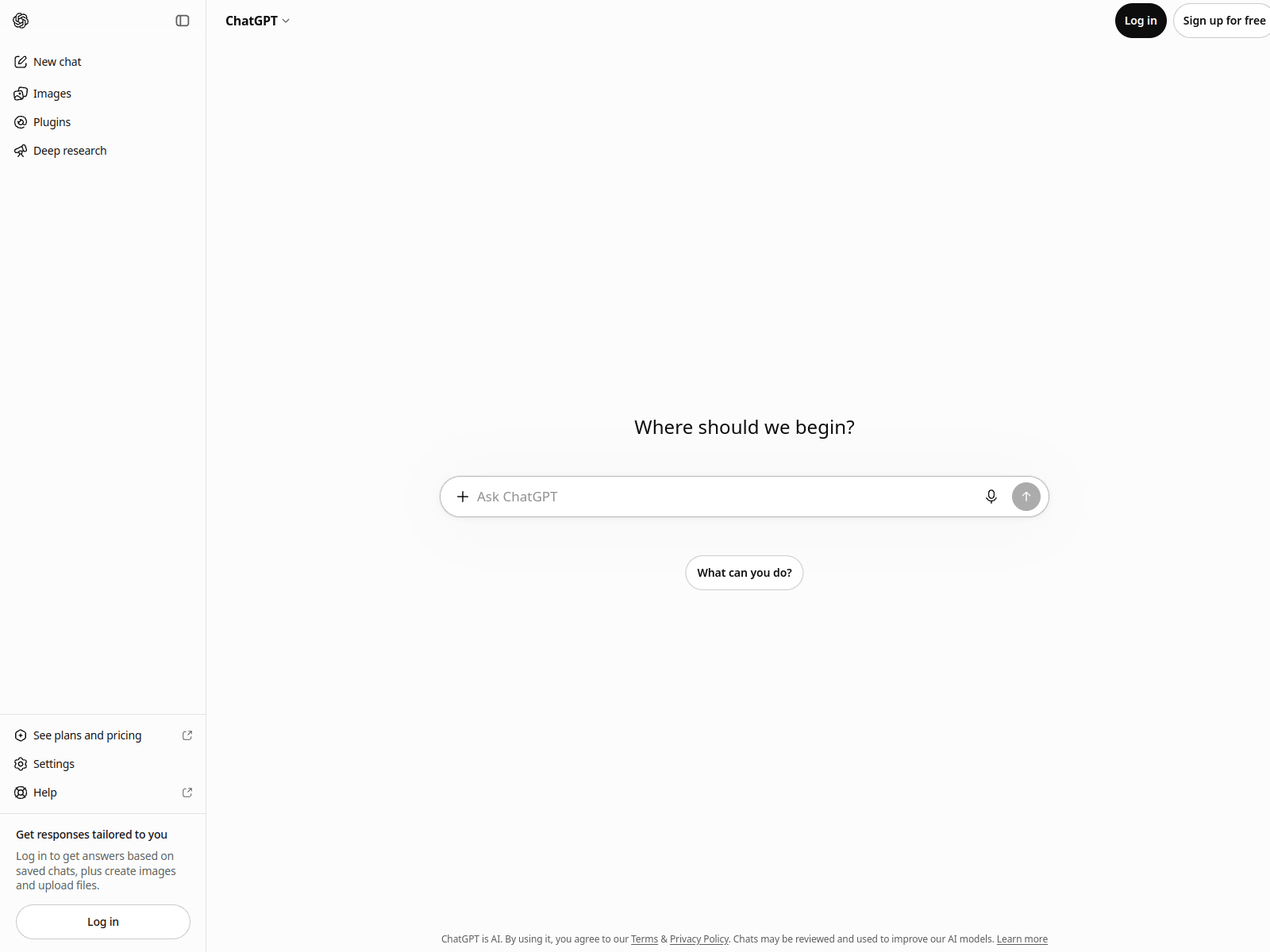
Overview
- Tool name: ChatGPT
- Developer: OpenAI
- Official website: https://chatgpt.com/
- Category: AI Chatbots
ChatGPT is a conversational artificial intelligence tool developed by OpenAI, powered by advanced large language models. It interprets natural language inputs from users to generate structured text, code, or analytical insights, assisting users with daily tasks such as drafting text, retrieving information, and summarizing data.
Key Uses
- Text Generation and Editing: Assists in drafting emails, reports, and articles while adjusting tone, style, or correcting grammatical errors based on user instructions.
- Programming and Code Assistance: Writes code snippets in various programming languages, explains existing code logic, and helps identify or fix bugs.
- Information Retrieval and Q&A: Answers general knowledge questions across diverse fields like science, history, and technology, or simplifies complex concepts.
- Document Analysis and Summarization: Processes long documents, academic papers, or meeting transcripts to extract core arguments and key metrics.
Who It Is For
- Office Professionals: Individuals looking to streamline administrative tasks, draft business correspondence, and translate multilingual documents.
- Software Developers: Programmers seeking implementation ideas, debugging assistance, or test case generation.
- Students and Researchers: Learners exploring new subjects who need explanations of complex theories or historical events.
Tips for Best Results
- Provide Detailed Context: Include specific background information, target audience, and formatting requirements in your prompts to receive more relevant outputs.
- Use Iterative Prompting: Refine and guide the AI through multi-turn conversations rather than expecting a flawless final result from a single prompt.
- Verify Critical Information: Always cross-check generated facts, figures, and technical logic against reliable external sources before relying on them for important decisions.
Limitations
- Potential for Inaccuracies: The model can occasionally generate plausible-sounding incorrect information, commonly known as hallucinations.
- Data Currency: Depending on the specific interface version and access tier, real-time event retrieval may vary.
- Data Privacy Considerations: Users handling sensitive personal or corporate data should review the platform's data retention and privacy policies before inputting confidential information.
Frequently Asked Questions
Is there a free version of ChatGPT available?
Yes, OpenAI provides free access to standard features for users worldwide. Anyone can sign up via the web interface to start chatting, while optional paid tiers are offered for users needing higher usage limits or advanced features.
Which languages does ChatGPT support?
ChatGPT supports a wide range of global languages, including English, Chinese, Spanish, French, and many others. It can fluently converse, translate, and process text across these supported languages.
Can I integrate ChatGPT into my own applications?
Yes, developers can utilize OpenAI's official API to integrate the model's capabilities into third-party software, websites, or internal tools. Detailed documentation, pricing models, and rate limits are available on the OpenAI developer platform.
Is the code generated by ChatGPT ready for production use?
It should be reviewed carefully. While it provides useful programming logic and scaffolding, generated code may contain edge-case bugs or security flaws and requires thorough testing and human oversight.