
Overview
- Tool name: Claude
- Developer: Anthropic
- Official website: https://claude.ai/
- Category: AI Chatbots
Claude is an AI assistant from Anthropic, an AI safety company based in San Francisco. It runs in a browser at claude.ai, in the desktop and mobile apps, through a pay-as-you-go API on the Claude Platform, and inside a terminal through Claude Code, Anthropic's coding agent. One account covers all four.

The current line-up has four models, all with a 1M-token context window and a 128K-token maximum output, all able to read text and images, and all with a training-data cutoff of June 2026. Anthropic suggests starting with Claude Opus 5.5 for most work: it is built for long-running agentic coding and knowledge work. Claude Sonnet 5.5 is pitched as the best balance of speed and intelligence and is what most chat sessions run on. Claude Haiku 5.5 is the fast, cheap option for classification, extraction and routing at volume. Claude Fable 5.1 is the top tier, meant for demanding reasoning and long-horizon agentic work when Opus 5.5 at higher effort still falls short.
What separates Claude from most assistants is less any single feature than the shape of the whole thing: very long context, thinking that is on by default and adapts to the task, an agent that can work in your terminal and your files, connectors that plug into the tools you already use, and explicit per-model retirement dates so you can plan migrations instead of guessing.
Key Uses
- Long documents and large codebases: Every current model accepts a 1M-token context, and Claude 4.6 and later models bill long requests at the same per-token rate as short ones, so a 900K-token request costs what 900K tokens cost. Drop in an entire codebase, a full contract, or a year of reports and ask across all of it.
- Agentic coding with Claude Code: Claude Code runs in your terminal, reads and edits files, runs commands and tests, and works through multi-step changes with you approving along the way. It is included in the Pro and Max subscriptions and also bills through the API.
- Writing, editing and analysis: Drafting, rewriting to a voice, summarizing, critiquing an argument, and turning rough notes into something sendable. Thinking is adaptive and always on for Opus 5.5 and Fable 5.1, which is where the quality on reasoning-heavy work comes from.
- Data work with code execution: Claude writes and runs Python in a sandbox for analysis, charts and file transformation rather than describing what the result would look like. Organizations get 50 free hours a day; additional container hours bill at $0.05 per hour.
- Research with web search: Web search gives Claude current information instead of only what it was trained on. It costs $10 per 1,000 searches on top of the input and output tokens the request uses, so it is worth switching off for work that does not need it.
- Agents, tools and connectors: Tool use lets Claude call your own functions, and connectors wire it into external services through MCP, so it can act rather than only answer. Managed Agents adds hosted runtimes at $0.08 per session hour for active runtime on top of standard token rates.
- High-volume classification and extraction: Haiku 5.5 exists for throughput: labeling, routing, extraction and structured output where latency and unit cost matter more than peak reasoning. Combine it with the Batch API for a 50% discount on input and output.
- Repeat work in Projects: Projects hold standing instructions and source files so recurring tasks start with context already loaded, instead of you re-explaining the brief every session.
Pricing
- Free — $0. Access to Sonnet and Haiku, with usage limits that reset on a rolling five-hour window. Context up to 1M depending on model. You can opt out of model training.
- Pro — $20 per month billed monthly, or $17 per month on the annual plan ($200 billed up front). At least 5x the usage of Free per five-hour session, Opus access, and usage credits so you can keep working at standard API rates after you hit the limit.
- Max 5x — $100 per month. 5x Pro usage, higher output limits, priority access at busy times, and $100 per month of included Claude Platform API credits that do not expire.
- Max 20x — $200 per month. 20x Pro usage and $200 per month of included API credits.
- Team — $25 per seat per month billed monthly, or $20 per seat per month annually. Premium seats are $125 monthly or $100 annually and carry 5x the usage of a standard seat. For 2 to 150 people, with pooled API credits up to $500 per month, spend controls, and no model training on your content by default.
- Enterprise — $20 per seat per month billed annually, 20-seat minimum, with usage billed separately at API rates. Adds SCIM, audit logs, a compliance API, custom data retention, role-based access and a HIPAA-ready option.
- API — Fable 5.1: $10 per million input tokens, $50 per million output tokens.
- API — Opus 5.5: $4 input, $20 output per million tokens.
- API — Sonnet 5.5: $2 input, $10 output per million tokens.
- API — Haiku 5.5: $0.10 input and $0.50 output per million tokens for prompts up to 100K tokens; $0.50 input and $2.50 output above that threshold.
- Batch API — 50% off both input and output tokens for asynchronous work that can wait.
- Prompt caching — cached reads cost a fraction of a fresh input token: $0.20 per million for Opus 5.5 against $4 for a normal input token, and $0.10 against $2 for Sonnet 5.5.
Prices exclude applicable tax and Anthropic can change plans and prices at its discretion; check claude.com/pricing for consumer plans and the Claude Platform pricing page for API rates. Three things that move a real bill more than plan choice: US-only inference costs 1.1x input and output, Opus 5.5 has a fast mode that runs up to 2.5x faster at twice the standard price, and prompt caching cuts repeated context to roughly a twentieth of the input price. Usage on web, desktop, mobile and Claude Code all draw from the same pool, and paid plans add weekly limits on top of the rolling five-hour window.
Who It Is For
- Engineers: Claude Code plus a 1M context is the reason most developers pick it: it can hold a real repository, make changes across files, and run the tests. Opus 5.5 is the default for long-running agentic work; Haiku 5.5 for CI-scale classification.
- Writers, analysts and consultants: Long context plus adaptive thinking suits work built on large source material: summarizing a discovery dump, drafting against house style, or stress-testing an argument before it goes out.
- Teams that need governance: Team and Enterprise add the parts an organization actually asks about: no training on your content by default, admin spend controls, audit logs, SCIM provisioning, custom retention and a compliance API.
- Product and ops teams building with an API: Four price tiers from $0.10 to $10 per million input tokens let you route by task instead of paying the flagship rate everywhere. Batch halves the cost of anything asynchronous.
- Students and casual users: The Free plan runs on Sonnet and Haiku with generous limits and no card. Pro at $20 monthly is the step up when you want Opus and roughly five times the headroom.
- Anyone outside a supported region: Worth checking before you commit: Anthropic publishes a list of supported countries and regions, and mainland China is not on it. See the limitations below.
How to Use Claude
1. Check that Anthropic supports your country or region first. Anthropic maintains a supported-regions list and mainland China is not included, so confirm access before you build anything around it.
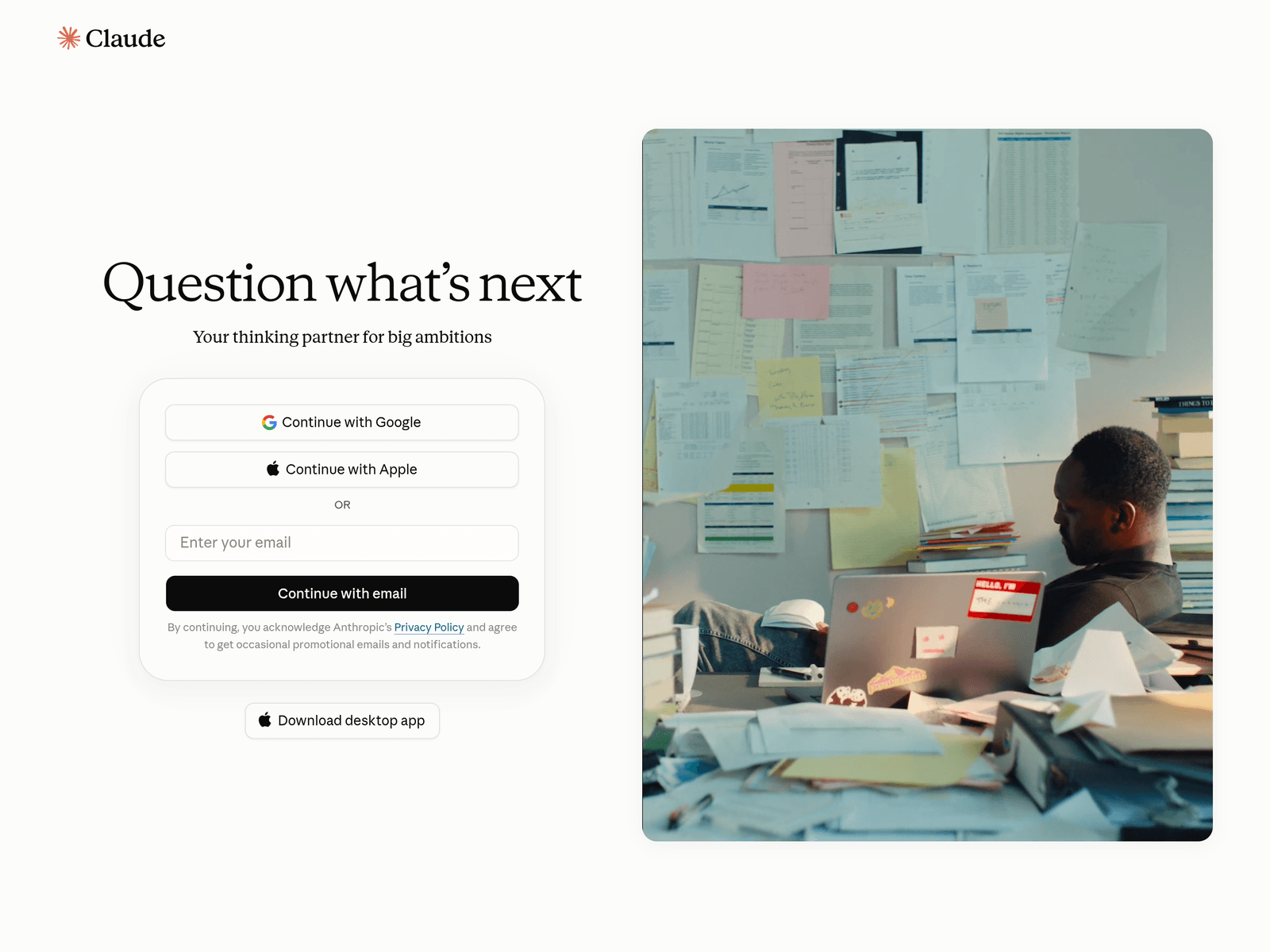
2. Open claude.ai and create an account with an email address, Google account, or Apple ID. No card is needed for the Free plan.
3. Start on Sonnet 5.5, which is what the Free plan and most chat sessions use. You do not need to pick a model to begin.
4. Ask the first real question in plain language, with the material attached if there is any. Drag in a PDF, spreadsheet, screenshot or code file; Claude reads images as well as text.
5. Turn on web search only when the answer depends on current information. It costs $10 per 1,000 searches, so leaving it on for everything is a needless charge.
6. Move to Opus 5.5 when the task is long, agentic or reasoning-heavy. Select it from the model picker; switching models mid-conversation is allowed.
7. Create a Project the second you notice a task repeating. Put the standing brief and reference files inside it once instead of pasting the same context every session.
8. For coding work, install Claude Code and run it in the project directory rather than pasting code into chat. It reads the repository, edits files and runs commands with your approval.
9. Connect the services you already use through connectors and MCP, giving each the narrowest scope that still does the job.
10. Watch the usage indicator. Limits reset on a rolling five-hour window, paid plans add weekly limits, and usage credits let you keep going at standard API rates once you hit the cap.
11. For API work, create a key in the Claude Platform console, pick the model by task, and start with Sonnet 5.5. Move down to Haiku 5.5 for volume and up to Fable 5.1 only when Opus 5.5 at high effort still falls short.
12. Add prompt caching before you optimize anything else. Put stable instructions and reusable documents at the front of the request so they become cache reads, which cost a fraction of fresh input tokens.
13. Export or copy the result and spot-check anything factual. Claude is confident-sounding by default, and that is exactly when a wrong detail is most likely to survive a skim.
Tips for Best Results
- Start on Sonnet, escalate on purpose. Sonnet 5.5 handles most work at half the price of Opus 5.5. Reach for Opus when the task is long or agentic, and for Fable 5.1 only when Opus at high effort still misses.
- Cache the stable part of every prompt. Cached reads on Opus 5.5 cost $0.20 per million against $4 for a fresh input token. Put system instructions and reference material at the front, and keep the changing part at the end.
- Batch anything that can wait. The Batch API takes 50% off input and output. Overnight classification, extraction and summarization jobs belong there.
- Watch Haiku 5.5's 100K threshold. Pricing steps up above 100K tokens in a single prompt, and the threshold counts all input tokens including cache reads. Chunking can be cheaper than one long request.
- Use effort levels instead of a bigger model. Turning effort up on a cheaper model often beats switching to a pricier one, and it is the first knob Anthropic suggests trying.
- Give files, not descriptions. A real PDF, spreadsheet or repository beats a summary of it. Long context is billed at a flat per-token rate, so there is no long-context surcharge to avoid.
- Let Projects carry the standing brief. Anything you have explained twice belongs in a Project with the source files attached.
- Keep web search off by default. At $10 per 1,000 searches it should be a deliberate choice, not a permanent setting.
- Check the retirement date before you hard-code a model ID. Each model lists an earliest retirement date; Opus 5.5 is not retired sooner than September 22, 2027. Use aliases and plan the migration.
Limitations
- Mainland China is not a supported region. Anthropic publishes a supported-regions list and mainland China is absent from it; the developer documentation returns an unavailable-in-region notice from there. Access typically requires being in a supported region and complying with local rules, which is your responsibility to confirm.
- Free cannot reach the flagship models. The Free plan gets Sonnet and Haiku only. Opus needs Pro or above, and Fable 5.1 counts against usage credits on Pro or 50% of weekly limits on Max and premium Team seats.
- Usage limits are real, and shared. Limits reset on a rolling five-hour window, paid plans add weekly limits, and everything you do on web, desktop, mobile and Claude Code draws from the same pool. There is no fixed message count, so heavy sessions run out faster.
- The knowledge cutoff is June 2026. Without web search, Claude will not know about anything later, and it will not flag that gap on its own.
- Fable 5.1 is expensive. At $10 and $50 per million input and output tokens it is 2.5x Opus 5.5. Reaching for it by default is the fastest way to an ugly bill.
- Thinking is always on for Opus 5.5 and Fable 5.1. That is what makes them strong on hard reasoning, and also what makes them slower and more expensive per answer than a model you can turn down.
- Hallucinations look like everything else. Claude writes in a confident register, so wrong citations, invented APIs and stale figures read the same as correct ones until checked.
- Prices, limits and model names move. Anthropic states it can change plans at its discretion, retires model versions on a published schedule, and has changed model naming before. Anything cost-critical needs a quarterly recheck.
- Consumer plans are individual. Team starts at two seats and Enterprise at twenty, so there is no small shared-team tier, and per-seat pricing adds up faster than a single Max subscription for one or two people.
Frequently Asked Questions
Is Claude free?
Yes. The Free plan costs nothing and gives you Sonnet and Haiku with usage limits that reset on a rolling five-hour window. Pro is $20 per month billed monthly or $17 per month annually ($200 up front) and adds Opus, at least 5x the usage, and usage credits.
Which Claude model should I use?
Anthropic suggests starting with Opus 5.5 for most workloads. Use Sonnet 5.5 when speed and cost matter and the task is not long-horizon, Haiku 5.5 for high-volume classification and extraction, and Fable 5.1 only for demanding reasoning when Opus 5.5 at higher effort still falls short.
Is Claude available in mainland China?
No. Anthropic maintains a published list of supported countries and regions, and mainland China is not on it; requests to the developer documentation from there return an unavailable-in-region notice. Check the official supported-regions page before relying on it, and make sure any access arrangement complies with local rules.
How long is the context window?
1M tokens on every current model, with up to 128K tokens in a single response. Claude 4.6 and later models, with the exception of Haiku 5.5, bill long requests at standard per-token rates, so there is no long-context surcharge.
What happens when I hit the usage limit?
You wait for the rolling five-hour window to reset or upgrade. On paid plans you can also turn on usage credits and keep working at standard API rates. Usage is pooled across web, desktop, mobile and Claude Code, and paid plans carry weekly limits as well.
Does Anthropic train on my conversations?
On Free, Pro and Max you can opt out of model training. On Team and Enterprise, no training happens on your content by default. Enterprise also adds custom data retention controls, audit logs and a compliance API.
How much does the API cost?
Per million tokens: Fable 5.1 is $10 in and $50 out; Opus 5.5 is $4 and $20; Sonnet 5.5 is $2 and $10; Haiku 5.5 starts at $0.10 and $0.50 for prompts up to 100K tokens. The Batch API takes 50% off, and prompt caching cuts repeated context to a small fraction of the input price.
What is Claude Code, and is it included?
Claude Code is Anthropic's coding agent that runs in your terminal: it reads and edits files, runs commands and tests, and works through changes with your approval. It is included with Pro and Max subscriptions and also available through the API.