
Overview
- Tool name: LLaMA
- Developer: GitHub
- Official website: https://github.com/facebookresearch/llama
- Category: AI Models
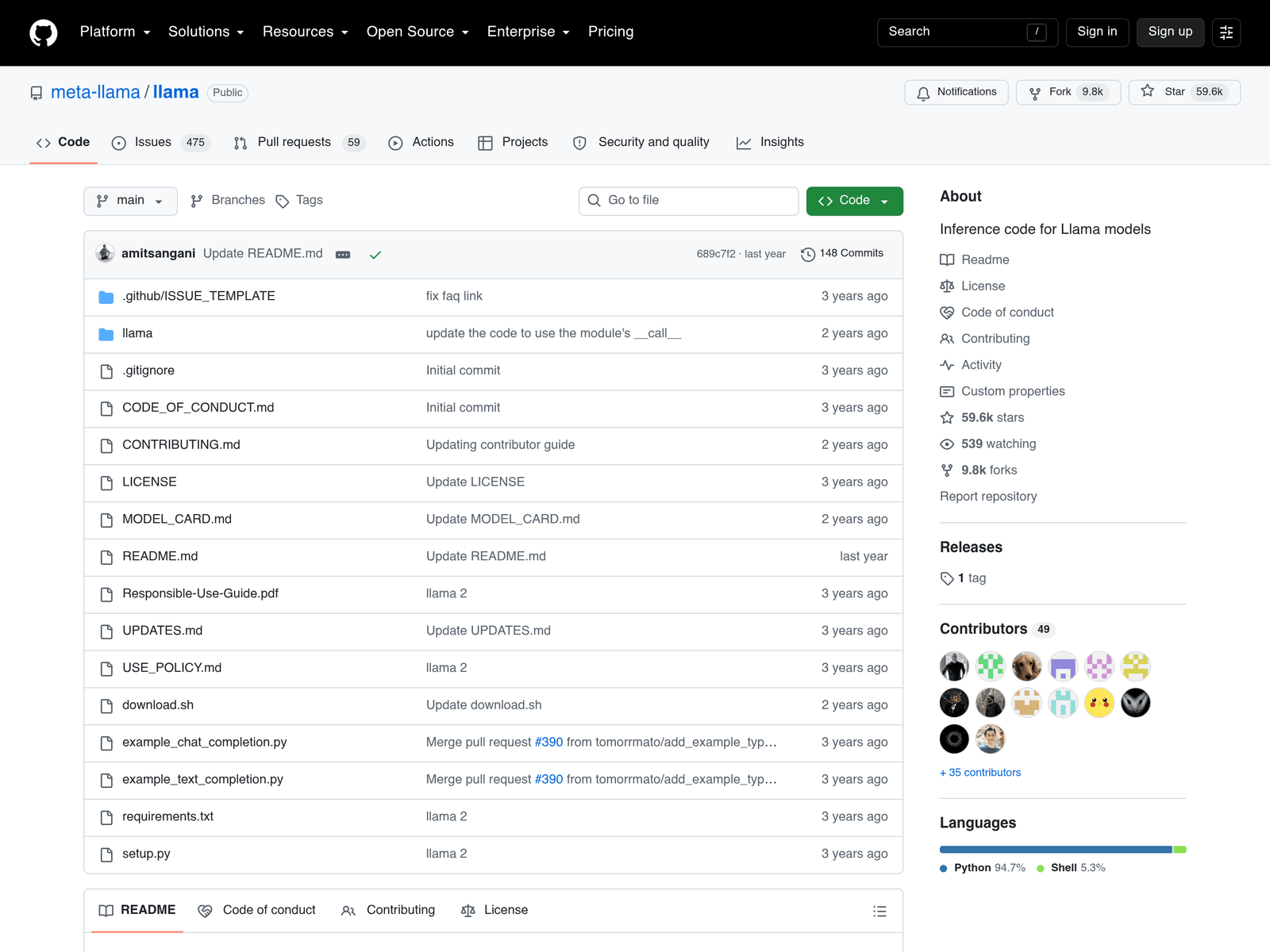
LLaMA is an open large language model family by Meta, with this repository providing inference code for research and development. It supports text completion and chat-based generation, enabling local deployment and experimentation. The repo includes example scripts and dependency files for quick setup.
Key Uses
- Provides inference code for Llama models, supporting both text completion and chat completion tasks through ready-to-run Python examples.
- Includes example_chat_completion.py and example_text_completion.py to demonstrate distinct interaction patterns, helping users select the right approach for their use case.
- Ships with requirements.txt and setup.py for dependency management, allowing developers to install necessary packages in a controlled environment.
- Contains MODEL_CARD.md and Responsible-Use-Guide.pdf, offering model background and usage guidelines to support ethical and compliant deployment.
- Features download.sh to streamline model weight acquisition, reducing manual steps in the setup process.
Who It Is For
- Researchers can use the repository to reproduce baseline inference capabilities of Llama models for NLP experiments and benchmarking.
- Developers may build local language applications such as support bots, summarization tools, or knowledge assistants using the provided codebase.
- Educators can leverage it to teach fundamentals of large language model loading, prompting, and inference workflows.
- Enterprise teams can evaluate model fit for internal workflows, including integration tests or domain-specific adaptation studies.
Tips for Best Results
- Review README.md and UPDATES.md before running code to understand current capabilities and avoid deprecated components.
- Use a virtual environment to install dependencies from requirements.txt, ensuring compatibility and reducing conflicts with system packages.
- If accessing models via Hugging Face, complete any required registration or authorization steps in advance to prevent download interruptions.
- Consult the Responsible-Use-Guide.pdf to assess output risks and define appropriate use boundaries, especially in sensitive or automated contexts.
Limitations
- The repository notes “(Deprecated) Llama 2,” indicating older model versions or interfaces may no longer be maintained; new projects should follow current recommendations.
- Only inference code is provided—training or fine-tuning pipelines are not included, requiring additional tooling for model customization.
- Model weights must be downloaded via script or Hugging Face, which may involve access controls or regional restrictions that need prior verification.
Frequently Asked Questions
How do I get started with LLaMA?
Clone the repository and install dependencies from requirements.txt, then run download.sh to fetch model weights. Choose either example_chat_completion.py or example_text_completion.py based on your task. Read README.md first for environment setup details.
Is LLaMA free to use?
The code is open-source and free, but model weights are subject to Meta’s use policy. Some resources require Hugging Face access, with licensing terms shown on the official page.
What platforms does LLaMA support?
The Python-based code runs on Linux, macOS, and Windows. Performance depends on hardware, particularly GPU or accelerator availability.
How does LLaMA differ from other open LLMs?
LLaMA, released by Meta, emphasizes open weights and efficient inference, making it suitable for research and customization. Unlike closed models, it offers transparency, but unlike full frameworks, this repo focuses only on inference.
Are there alternatives to LLaMA?
Comparable open models include Mistral, Qwen, and the Llama 3 series. Selection should consider task needs, hardware, and license terms. Hosted APIs also offer a cloud-based alternative to local deployment.