
Overview
- Tool name: AstraFlow AI Platform
- Developer: UCloud
- Official website: https://www.ucloud.cn/site/active/astraflow
- Category: AI Platforms
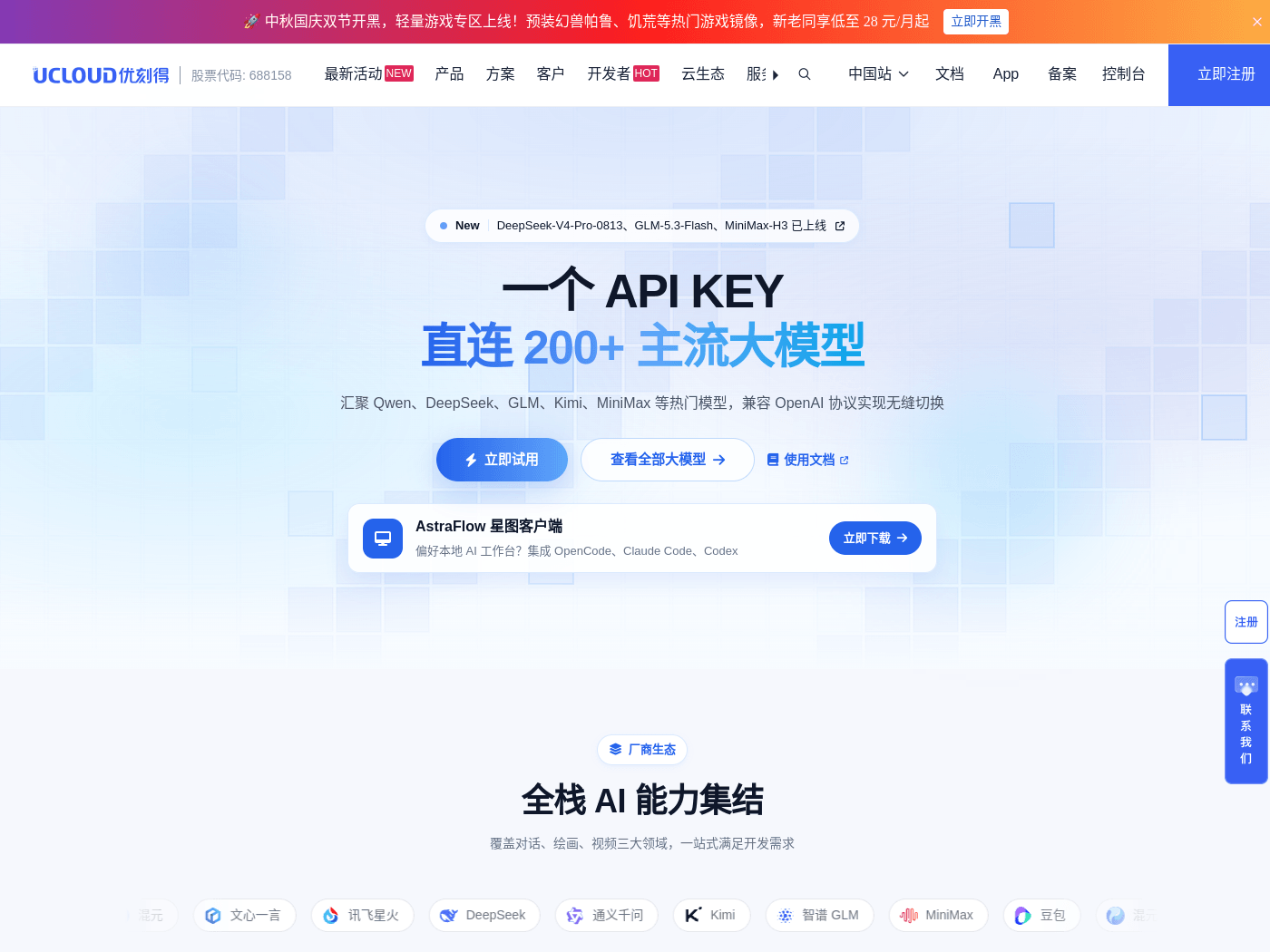
AstraFlow AI Platform is a large-model aggregation service from UCloud. It provides one API key for calling 200+ models, including DeepSeek, Qwen, GLM, Kimi, and MiniMax. The platform supports OpenAI-compatible access, making it easier for developers to connect language, image, and video models without rebuilding existing code.
Key Uses
- Unified model access: AstraFlow AI Platform lets developers use one API key to call 200+ mainstream models, reducing the need to manage separate accounts and credentials for each model provider.
- OpenAI-compatible integration: The platform is described as compatible with the OpenAI protocol, so projects already using OpenAI-style SDK calls may switch the endpoint and model ID instead of rewriting the integration layer.
- Language model calls: The catalog includes large language models for dialogue, reasoning, code generation, and long-context tasks, covering names such as DeepSeek, Qwen, GLM, Kimi, and MiniMax.
- Image generation access: AstraFlow AI Platform also lists image generation models, including text-to-image, image-to-image, and visual understanding options, which can support creative and multimodal workflows.
- Video generation access: The platform includes video generation models for text-to-video, image-to-video, and multimodal video creation, giving developers a single entry point for several media generation tasks.
Who It Is For
- Application developers: Developers building AI-powered apps can use AstraFlow AI Platform to test and connect multiple models without setting up separate integrations for each provider.
- Teams comparing models: Teams that need to evaluate output quality, latency, pricing, or task fit across DeepSeek, Qwen, GLM, Kimi, MiniMax, and other models may benefit from a shared API endpoint.
- Multimodal product builders: Projects that combine chat, image generation, or video generation can use the platform as a centralized way to access different model categories.
- Enterprise users needing support: UCloud mentions multi-supplier scheduling, dedicated resource pools, and 7x24 technical support, which may be relevant for organizations with stability or service requirements.
Tips for Best Results
- Check the exact model ID: Model names and versions may differ across providers, so confirm the target model ID in the platform list or documentation before making the first API call.
- Reuse existing OpenAI code: If a project already uses an OpenAI SDK, update the base URL, API key, and model field first. This is usually the fastest way to evaluate AstraFlow AI Platform without major refactoring.
- Match models to tasks: Language models, image models, and video models have different capabilities. Choose a model category based on the task instead of assuming one model can handle every workflow.
- Review pricing rules carefully: The platform shows different pricing styles, such as per-token pricing, fixed pricing, peak and off-peak pricing, image-based pricing, and video-second pricing. Confirm the billing unit before production use.
Limitations
- Model availability may change: The displayed model list, versions, and pricing may be updated as providers release new models. Check the console or documentation for the latest access details.
- Account setup is required: UCloud states that users need to register and complete required account steps before using the service, so anonymous or unregistered access is not the main workflow.
- Displayed prices may not cover all cases: Pricing shown on the page may not reflect every account tier, promotion, resource pool, or usage condition. Production cost estimates should be confirmed inside the platform.
Frequently Asked Questions
How do I start using AstraFlow AI Platform?
Start by registering a UCloud account and creating an API key in the console. Then configure the API endpoint, key, and model ID in your code or AI tool. After that, you can call the models available through the platform.
Which models does AstraFlow AI Platform support?
AstraFlow AI Platform aggregates 200+ models across language, image, and video categories. The listed families include DeepSeek, Qwen, GLM, Kimi, MiniMax, and other image or video generation models, with exact availability shown in the platform catalog.
Is AstraFlow AI Platform compatible with OpenAI SDKs?
UCloud describes the platform as compatible with the OpenAI protocol. Developers can typically point an OpenAI-compatible client to the AstraFlow endpoint, provide an API key, and specify a model ID for calls.
Is AstraFlow AI Platform suitable for production applications?
The platform mentions multi-supplier scheduling, dedicated resource pools, enterprise security commitments, and technical support. However, teams should verify model availability, pricing, compliance requirements, and service terms before production deployment.
Does AstraFlow AI Platform offer a client or local tooling?
The platform page mentions an AstraFlow client and integration with local AI workstations such as OpenCode, Claude Code, and Codex. This may suit developers who prefer calling models from a local development environment.