
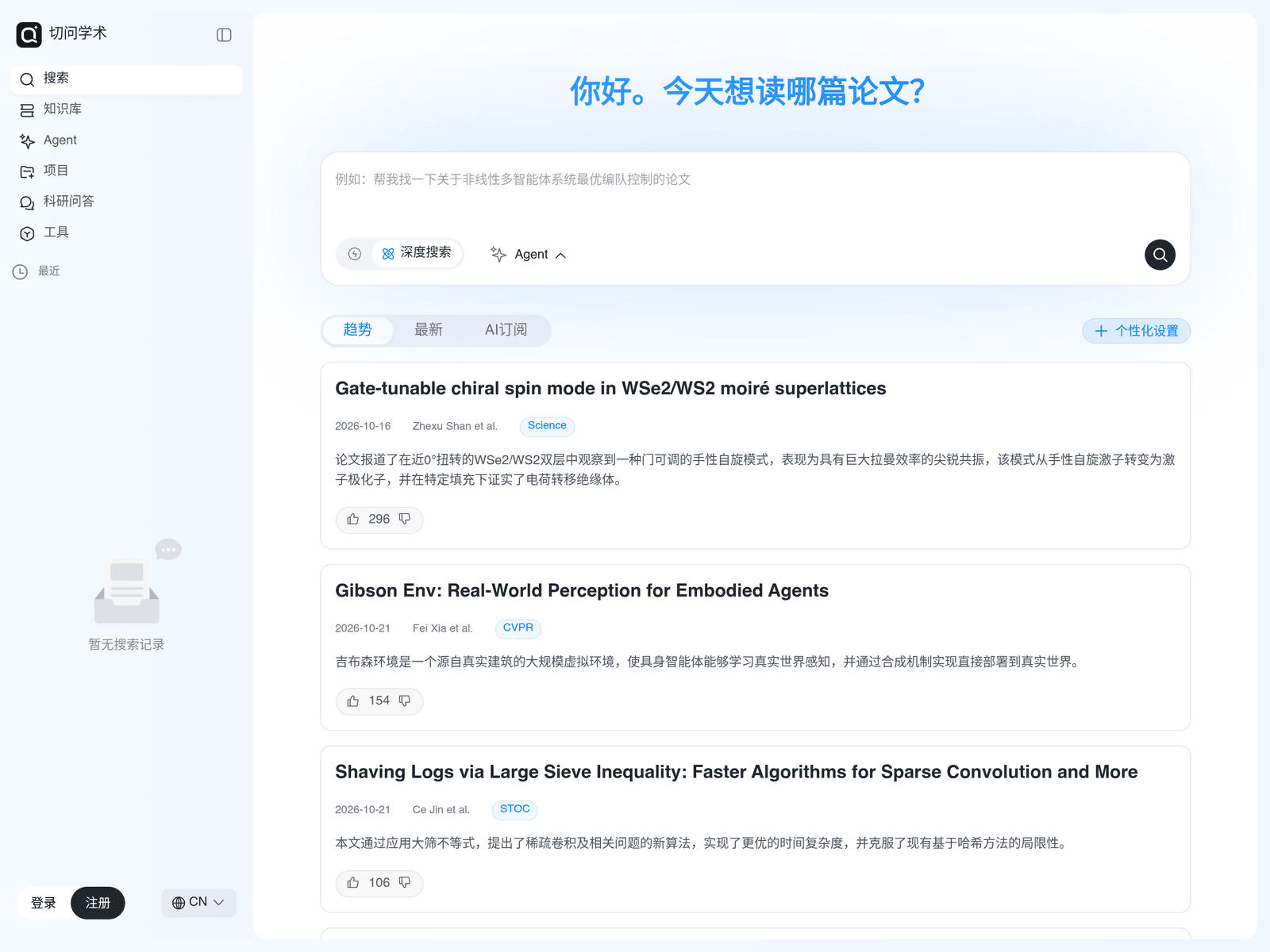
Overview
- Tool name: Qiewen Academic
- Developer: FudanNLP team
- Official website: https://qiewenpaper.cgref.cn/s/rpexzlvn90
- Category: AI Agents
Qiewen Academic is an AI academic agent built by the FudanNLP team. Qiewen Academic focuses on literature search and paper reading. Details on features and access are listed on the official page.
Key Uses
- Literature search: describe a research topic in plain language and get help narrowing down relevant papers and sources instead of starting from a blank database screen.
- Paper reading: ask follow-up questions about a paper's motivation, method, and conclusions to work through sections that are hard to parse on a first read.
- Topic mapping: chain questions around one research direction so that scattered references turn into a clearer picture of what to read next.
- Terminology checks: look up unfamiliar terms and background concepts when reading papers from an adjacent field.
- Pre-writing groundwork: compare references before drafting a literature review or introduction, so the citation leads are easier to verify afterwards.
- Coursework support: use it as an extra explanation channel for questions that come up in a seminar or a self-study track.
Who It Is For
- Graduate students scoping a thesis topic who need a quick overview of representative work in a field.
- Researchers moving into an adjacent area who need to pick up its vocabulary and background first.
- Students and lab members preparing a literature review, a seminar talk, or a group meeting.
- Undergraduates working on a first substantial research paper who want guidance on where to search.
- Anyone reading papers outside their main specialty and looking for explanations along the way.
Tips for Best Results
- State the field, the research question, and the time window you care about; a single keyword rarely produces a useful answer.
- Reuse the exact terminology from the paper — method names, dataset names, metric names — instead of paraphrasing them.
- Treat every answer as a lead. Confirm authors, venue, and publication date on the publisher page before citing anything.
- Ask about method details in several rounds, covering data source, evaluation metric, and experimental setup, rather than in one long question.
- When two answers conflict, note the disagreement and check the original paper instead of picking one at random.
Limitations
- Generated answers can be incomplete or misaligned with the source paper, so conclusions and numbers should be verified before use.
- The pool of literature it can reach is described on the official page and may not cover every discipline or the newest publications.
- Qiewen Academic does not replace a structured search in subject databases; systematic reviews still need a documented search strategy.
- Full texts behind paywalls have to be obtained through legitimate channels such as institutional subscriptions.
Frequently Asked Questions
How do I start using Qiewen Academic?
Open the official page listed above and follow the on-screen steps. Public information does not spell out whether an account is required or how much text can be processed at once. Trying a small task first is a reasonable way to see what the output looks like.
Is Qiewen Academic free?
No public pricing or free-quota details were found. Whether the service is free, metered, or subscription-based should be confirmed on the official page before planning long-term use. For occasional lookups, comparing it with other channels first is sensible.
Which platforms and languages does it support?
The confirmed entry point is a web address; whether mobile apps, browser extensions, or an API exist is not stated publicly. The range of supported languages should also be checked on the official page. Testing a handful of English papers is a practical way to gauge fit.
How is this different from a general-purpose AI chatbot?
Qiewen Academic is positioned around academic work — literature search, paper reading, and research support — rather than open-ended conversation. The practical difference depends on which sources it can search and how retrieval works, and that detail is not fully public. A side-by-side trial on your own topic is the clearest test.
Are there alternatives?
General AI assistants cover open-ended questions, while subject databases and reference managers remain the backbone of a systematic search. Qiewen Academic fits best between the two: map the territory first, then verify everything in the original papers.