
Overview
- Tool name: OpenHands
- Developer: OpenHands
- Official website: https://www.all-hands.dev/
- Category: AI Coding Tools
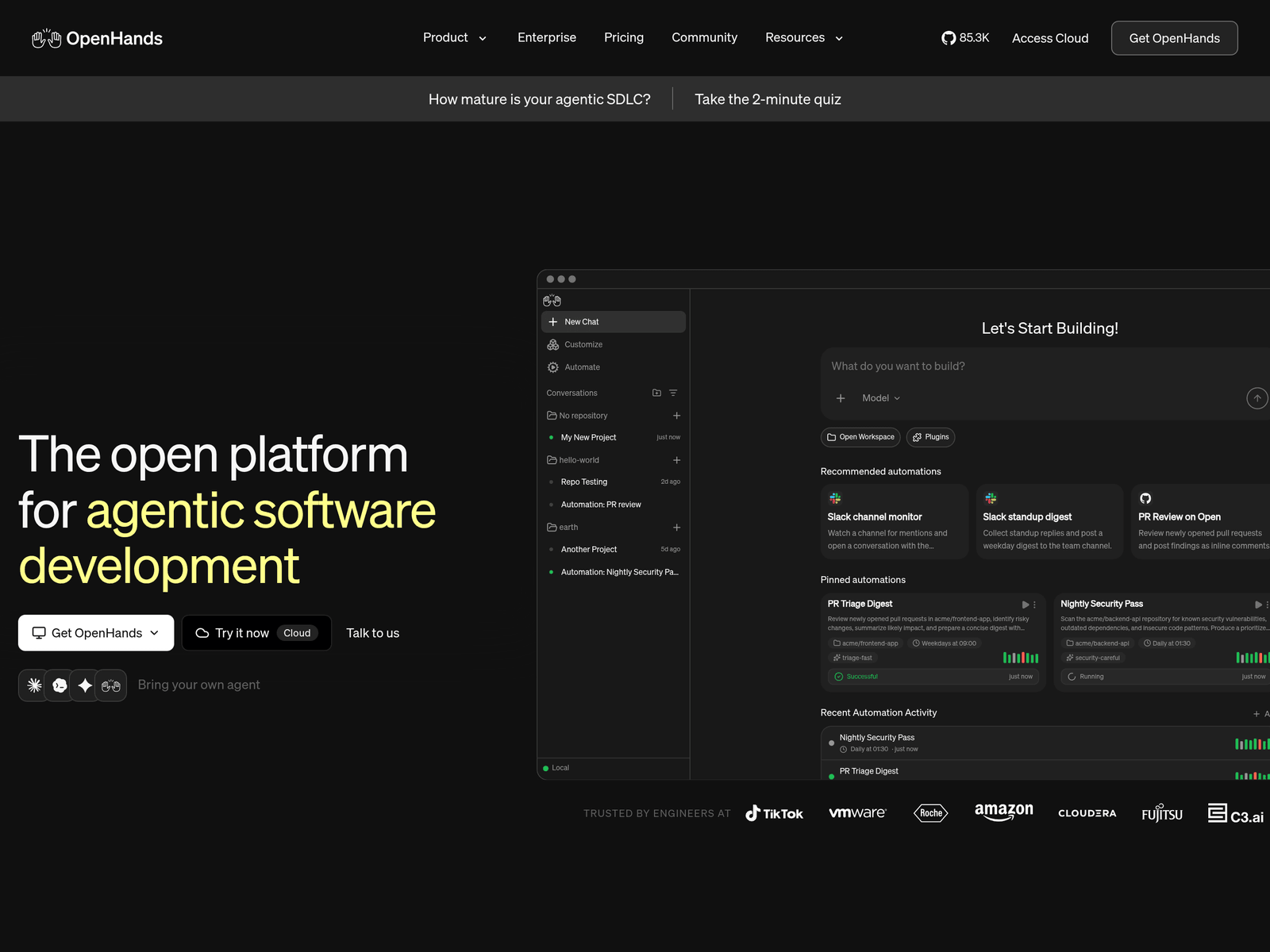
OpenHands is an open-source cloud coding agent platform in the AI coding tools category. It automates repetitive software engineering tasks such as pull request reviews, CI failure fixes, issue triage, and security scans. The platform integrates with common development workflows to reduce manual overhead.
Key Uses
- Automated pull request review: OpenHands watches for configurable labels on pull requests, inspects full context, and posts an AI-generated review comment once per label event.
- CI failure remediation: When continuous integration pipelines fail, OpenHands analyzes logs and recent changes to propose or apply fixes, reducing build downtime.
- Linear and Jira issue triage: For new Linear issues or Jira incidents, OpenHands classifies entries, suggests labels, identifies duplicates, and asks clarifying questions before work begins.
- Slack engineering request handling: OpenHands monitors Slack channels for @openhands mentions, opens a conversation with message context, and replies when the agent completes its task.
- Scheduled security scanning: OpenHands can run nightly scans of specified repositories to detect known vulnerabilities, outdated dependencies, and insecure code patterns, producing prioritized remediation summaries.
Who It Is For
- Engineering teams seeking PR review automation: Teams with frequent code submissions can use OpenHands to perform baseline reviews and flag risky changes before human reviewers step in.
- DevOps engineers managing CI pipelines: OpenHands helps accelerate incident response by automatically gathering logs and suggesting fixes when builds fail.
- Product and project teams handling high issue volume: OpenHands assists in initial triage of incoming bugs or feature requests, improving routing and reducing backlog noise.
- Security and compliance teams: The platform supports scheduled security scans that generate structured reports, enabling security staff to focus on validation and remediation.
Tips for Best Results
- Start with built-in automation templates: OpenHands offers templates for PR reviews, Slack monitoring, and security passes; new users should begin with these to understand triggers and output formats.
- Define precise trigger conditions: Limit automations to specific repositories, labels, or schedules to avoid unintended actions on unrelated changes.
- Integrate into existing toolchains: Since OpenHands works with GitHub, Slack, Jira, and Linear, embed it within current workflows rather than running it in isolation.
- Review automated outputs regularly: While OpenHands generates comments, fixes, or reports, critical decisions should still involve human validation to ensure alignment with project standards.
Limitations
- Requires external integrations: Most OpenHands automations depend on proper setup with platforms like GitHub or Slack; missing permissions or webhooks will prevent execution.
- Outputs need human verification: Code changes, review comments, or security findings from OpenHands are assistive and should not replace engineering judgment.
- Self-hosting entails operational responsibility: As an open-source platform, OpenHands allows self-deployment, but users must manage configuration, security, and updates themselves.
Frequently Asked Questions
How do I get started with OpenHands?
You can access OpenHands Cloud via the official website or deploy the open-source version yourself. The platform provides automation templates that connect to GitHub, Slack, Jira, or Linear for quick setup.
Is OpenHands free to use?
OpenHands is open source, so the core platform is freely available. A cloud offering also exists; pricing details are listed under Enterprise Pricing on the site, though no free tier is confirmed in the provided material.
Which tools does OpenHands integrate with?
OpenHands supports triggers from GitHub, Slack, Jira, Linear, scheduled jobs, and other supported integrations, covering code hosting, team communication, and project management workflows.
How is OpenHands different from GitHub Copilot?
OpenHands focuses on automating end-to-end engineering tasks like PR reviews and CI fixes, while GitHub Copilot primarily provides code completion. They operate at different levels of the development lifecycle.
Are there alternatives to OpenHands?
Other tools offer AI-powered code review or CI automation, but OpenHands distinguishes itself through its open-source model and broad integration with engineering platforms. Suitability depends on your team’s infrastructure and automation needs.